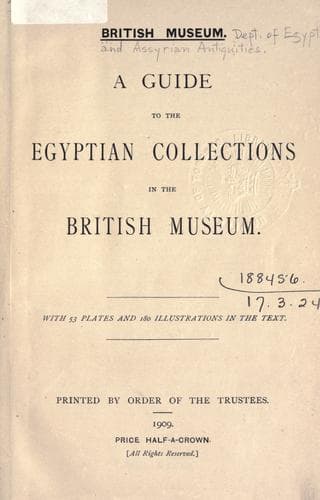
A guide to the Egyptian collections in the British MuseumBritish Museum. Department of Egyptian and Assyrian Antiquities
History
A guide to the Egyptian collections in the British Museum
British Museum. Department of Egyptian and Assyrian Antiquities
Egypt -- Antiquities
Of the monuments of the period in the British Museum may be specially
noted: Red granite seated figure of =Sekhem-uatch-taui-Rā=, a king of the
XIIIth or XIVth dynasty. This is a fine piece of sculpture, and is unlike
any other statue in the gallery. The body lacks the heaviness of the
statues of the earlier period. On the throne are cut, in outline, figures
of two lions placed back to back. Above them are the signs _sa ānkh_ 𓎂𓋹,
_i.e._, the “fluid of life,” which the king derived from Rā, the Sun-god
(see =Plate XXVII=; Bay 1, No. =276=). Of interest also are three stelae
of private individuals, each of which mentions the name of a king, viz.,
=Sekhem-ka-Rā= (see =Plate XXVIII=), with the Horus name of Sānkh-taui
(Bay 2, No. =277=), =Sebek-ḥetep=, with the prenomen of Khā-nefer-Rā (Bay
5, No. =278=), and =Ȧb-ȧā= (Bay 5, No. =279=). To this period belongs the
=axe handle= of =Sekhem-uatch-taui-Rā= (Sebek-ḥetep) a king (Table-case
E, Third Egyptian Room, No. 104). To a somewhat later period belong the
interesting =memorial cone= of the scribe Sebek-ḥetep, who flourished in
the reign of =Sebek-em-sa-f= (see =Plate XXIX=), of the XIVth dynasty,
a unique object (Bay 1, No. =280=), and the royal inscribed green stone
=scarab, with a human face=, set in a gold plinth, which probably came
from the tomb of this king at Thebes (Table-case J, Fourth Egyptian Room,
No. 195). Of interest, too, are the =royal stele= of the little-known
king =Ȧp-uat-em-sau-f= (Bay 3, No. =281=); the stele of =Ḥetep-neteru=
and =Teḥuti-āa=, which mentions another hitherto unknown king (Bay 4,
No. =282=); the stele of Ptaḥ-sānkh, mentioning king =Rā-Ḥetep= (Bay 5,
No. =283=); and the slab from the temple of Osorkon II at Bubastis,
inscribed with the name of =Sekhem-khu-taui-Rā= (Bay 23, No. =284=).
To a great many stelae of private individuals, who flourished between the
XIIth and the XVIIIth dynasties, it is difficult to assign exact dates,
for very few of them mention royal names, and the inscriptions cut on
them afford no clue. Fine examples of the transition period of funerary
sculpture, stelae, etc., are: Stele of =Nebȧ=, an inspector (Bay 1, No.
=285=); grey granite =portrait figure= of an official of Athribis (Bay
2, No. =288=); granite figure of =Nefer-ȧri=, from Bubastis (Bay 2, No.
=289=); stele of =Pai-neḥsi=, the store keeper of the gold which came
from the Sûdân (Bay 7, No. =299=); stele of =Ȧntef-Ȧqer-ānkh-khu= (Bay 7,
No. =301=); stele of Queen =Mer-seḳer= (Bay 9, No. =330=).
Public-domain text, read in full here on John Shaqi.
Reviews
Reviews
No reviews yet
Be the first to share your thoughts on this work.
Elsewhere in the archive
Join the Discussion
Join the discussion
Sign in to leave a comment or review.
Sign InorCreate an account