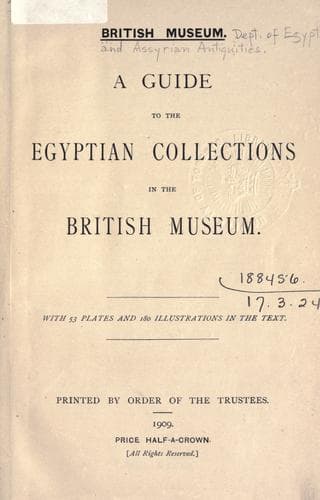
A guide to the Egyptian collections in the British MuseumBritish Museum. Department of Egyptian and Assyrian Antiquities
History
A guide to the Egyptian collections in the British Museum
British Museum. Department of Egyptian and Assyrian Antiquities
Egypt -- Antiquities
We now come to a period, _i.e._, that of the =XIIIth, XIVth, XVth, XVIth,
and XVIIth= dynasties, which is full of difficulties. Not only is the
order of the succession of the kings of these dynasties unknown, but
authorities differ greatly in their estimate of the length of the period
of their rule. Some say that the interval between the XIIth and the
XVIIIth dynasties consisted of more than 500 years, and others that it
was less than 200 years. The figures given by Manetho are as follows:—
=XIIIth= =dynasty.= From Thebes. 60 kings in 453 years.
=XIVth= ” ” Xoïs. 76 ” in 184 (or 484 years).
=XVth= ” =Shepherds.= 6 ” in 284 years.
=XVIth= ” =Shepherds.= 32 ” in 518 years.
=XVIIth= ” =Shepherds.= 5 (?) kings in 151 years.
[Illustration: PLATE XXVII.
Granite statue of King Sekhem-uatch-taui-Rā.
XIIIth or XIVth dynasty, B.C. 2000.
[Northern Egyptian Gallery, Bay 1, No. 276.]]
[Illustration: PLATE XXVIII.
Stele of the reign of Sekhem-ka-Rā, a king of the XIIIth dynasty, about
B.C. 2000.
[Northern Egyptian Gallery, Bay 2, No. 277.]]
[Illustration: PLATE XXIX.
Memorial cone of Sebek-ḥetep, a scribe, who flourished in the reign of
Sebek-em-sa-f, B.C. 2000.
XIIIth dynasty.
[Northern Egyptian Gallery, Bay 1, No. 280.]]
The total of these years is 1,590 according to one reckoning and 1,290
according to another, but it is impossible to accept either, and we must
therefore assume that the total of 1,590 or 1,290 years represents the
length of the reigns of the kings at Thebes, and of those who ruled in
the Delta. In fact it is clear that, except at rare intervals, between
the XIIth and the XVIIIth dynasties a king of the North and a king of the
South were always reigning at the same time in Egypt, and that neither
was sufficiently strong to make himself master of the whole country. The
evidence derived from the monuments seems to indicate that the power of
the Theban kings declined steadily at the beginning of this period, and
that, as it declined, the power of the nomad Semites from the east, who
are known as =Hyksos= or =Shepherds=, increased until the end of the
period, when the Theban kings became strong enough to make themselves
masters of the whole country. The names of a considerable number of
kings, who may be assumed to have reigned during the XIIIth and XIVth
dynasties, are known from scarabs and larger monuments, but nothing is
known of their reigns.
Public-domain text, read in full here on John Shaqi.
Reviews
Reviews
No reviews yet
Be the first to share your thoughts on this work.
Elsewhere in the archive
Join the Discussion
Join the discussion
Sign in to leave a comment or review.
Sign InorCreate an account