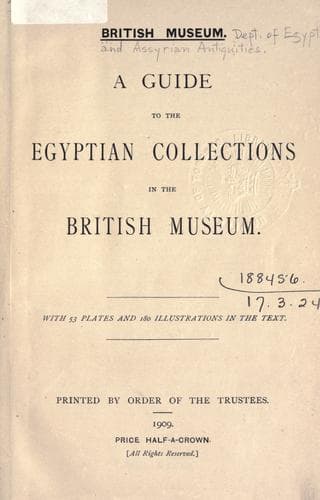
A guide to the Egyptian collections in the British MuseumBritish Museum. Department of Egyptian and Assyrian Antiquities
History
A guide to the Egyptian collections in the British Museum
British Museum. Department of Egyptian and Assyrian Antiquities
Egypt -- Antiquities
The reign of =Thothmes IV= was short and unimportant. He made one or more
raids into Nubia, an expedition into Syria; and in the first year of his
reign he set up a tablet between the paws of the =Sphinx= stating that
the =god of the Sphinx=, Ḥerukhuti-Kheperȧ-Rā-Temu, appeared to him one
day before he was king, and bade him remove the sand which had closed
him in on all sides, and promised him that he should become king if he
obeyed. Thothmes undertook the work, and in due course became king. His
inscription mentions king =Khāf-Rā= (Chephren) in connexion with some
work (probably a clearing of the sand) performed for the Sphinx. Among
the monuments of his reign may be noted the =stele of Ȧmen-ḥetep=, an
officer who accompanied the king into Western Asia and the Sûdân (Bay 11,
No. =377=); and the stele of =Nefer-ḥāt=, overseer of the works in the
Temple of Abydos (Bay 8, No. =378=). Thothmes IV married a lady named
=Mut-em-uȧa=, who became the mother of Ȧmen-ḥetep III. The =granite boat=
which was dedicated to the queen as the counterpart of the goddess Mut,
is exhibited in the Northern Gallery (Bay 7, No. =379=). For a portion of
the head of her seated figure from the boat see Bay 7, No. =380=. Some
think that Mut-em-uȧa is to be identified with the daughter of Artatama,
king of Mitani.[36]
[Sidenote: B.C. 1450.]
=Ȧmen-ḥetep III=, the =Memnon= of the Greeks, declared himself to be an
incarnation of the god Ȧmen-Rā; he reigned about 36 years. In the fifth
year of his reign he marched into the Sûdân and crushed a rebellion at
Abhat, taking 750 prisoners. He subsequently travelled in many parts
of that country, and built a magnificent temple there, near the modern
village of Ṣulb (Soleb), which he dedicated to himself as the god of the
Sûdân. He made many expeditions into Western Asia, and whilst there he
enjoyed lion-hunting on a large scale; on the large =scarabs= exhibited
in Table-case D (Fourth Egyptian Room) he states that he shot with his
own hand one hundred and two fierce lions during the first ten years of
his reign. His frequent visits to Western Asia enabled him to continue
the friendly personal relations with the kings and rulers which his
father inaugurated; and he married several of their daughters, _e.g._, a
daughter of Kadashman-Bêl, king of Karaduniyash; a daughter of Shutarna,
king of Mitani; and a daughter of Tushratta, king of Mitani. He also
married a sister of Tushratta called Gilukhipa, who arrived in Egypt
with three hundred and seventeen of her principal women. The greatest
and best beloved of his wives, however, was =Thi=, who must also have
been of foreign extraction. Judging by the appearance of the mummies of
her father, Iuȧa and her mother Thuȧa, which have recently been found,
it seems that the former was not an Egyptian, but a native of some part
of the Eastern Desert or Southern Syria, while the latter was a native
Egyptian woman. Their daughter Thi was a very remarkable woman in every
Public-domain text, read in full here on John Shaqi.
Reviews
Reviews
No reviews yet
Be the first to share your thoughts on this work.
Elsewhere in the archive
Join the Discussion
Join the discussion
Sign in to leave a comment or review.
Sign InorCreate an account