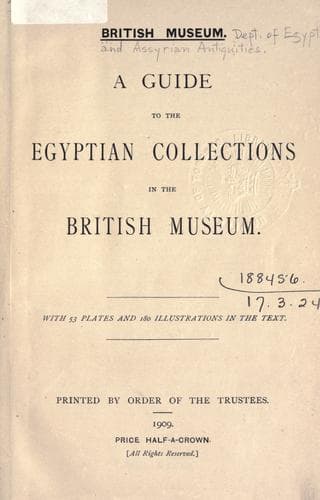
A guide to the Egyptian collections in the British MuseumBritish Museum. Department of Egyptian and Assyrian Antiquities
History
A guide to the Egyptian collections in the British Museum
British Museum. Department of Egyptian and Assyrian Antiquities
Egypt -- Antiquities
way, and it seems beyond question that her son Ȧmen-ḥetep IV derived from
her the monotheistic views which he held.
[Illustration: The Temple of Luxor, built by Ȧmen-ḥetep III, B.C. 1450.]
The building operations of Ȧmen-ḥetep III were on a very large scale,
and extended from one end of Egypt and Nubia to the other. He built
the =Apis chapels= at Ṣaḳḳârah; at Thebes he built a pylon; at Karnak
the temple dedicated to the Theban triad, Ȧmen-Rā, Mut and Khensu; in
the Southern Ȧpt (_i.e._, Luxor), a temple to =Menthu=, and a temple to
the goddess Mut, from which come the series of =statues of Sekhet=, a
fire-goddess, exhibited in the Northern Egyptian Gallery, Nos. =381-410=.
All these buildings were on the east bank of the Nile. On the west bank
he erected a great temple, the =Memnonium=, and in front of it set up
two huge statues of himself which are generally known as the =Colossi
of Memnon= (see =Plate XXXIII=). The northern statue was said to emit a
sweet, sad note daily at sunrise, and for this reason was known as the
“vocal statue of Memnon”; the sound was never heard after the statue was
repaired by the Emperor Septimius Severus (A.D. 193-211). Ȧmen-ḥetep
III also built a temple at Al-Kâb, and another to the god Khnemu at
Elephantine, and at Saddênga in the Sûdân he built a temple in honour of
his wife Thi, who was also probably worshipped there, as the king himself
was worshipped in his temple at Ṣulb, which has already been mentioned.
[Illustration: PLATE XXXII.
Colossal seated statue of Ȧmen-ḥetep III, B.C. 1450.
[Northern Egyptian Gallery, Bay 8, No. 412.]]
[Illustration: PLATE XXXIII.
The statues of Ȧmen-ḥetep III, B.C. 1450, commonly known as “The
Colossi.” The statue on the right is the famous “Colossus of Memnon,”
from which a sound was said to issue at dawn.]
Public-domain text, read in full here on John Shaqi.
Reviews
Reviews
No reviews yet
Be the first to share your thoughts on this work.
Elsewhere in the archive
Join the Discussion
Join the discussion
Sign in to leave a comment or review.
Sign InorCreate an account