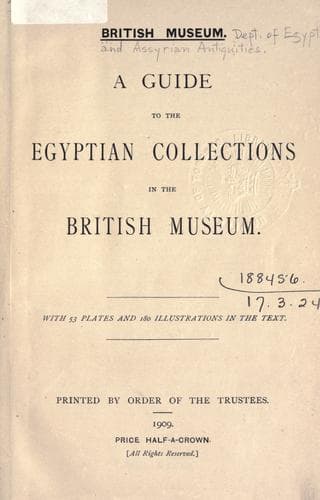
A guide to the Egyptian collections in the British MuseumBritish Museum. Department of Egyptian and Assyrian Antiquities
History
A guide to the Egyptian collections in the British Museum
British Museum. Department of Egyptian and Assyrian Antiquities
Egypt -- Antiquities
=567=); three painted slabs from the tomb of Seti I (Central Saloon, Nos.
=568-570=); and a grey =granite clamp= from a wall in Seti’s temple at
Abydos, inscribed with his prenomen 𓍹𓇳𓏠𓁦𓍺, (Bay 18, No. =572=). Among
smaller objects may be noted the =scarabs=, glazed =vase=, and =ushabtiu
figures= of the king exhibited in the Second and Fourth Egyptian Rooms
(Wall-cases 78, 79, 150 and 152). A stele set up by him at Wâdî Ḥalfah in
the first year of his reign is in Bay 13 (No. =574=), and the stele of
=Rumā=, a scribe and priest in his temple at Abydos, is in Bay 11 (No.
=573=). The beautifully illustrated =Papyrus of Hunefer= was written in
this reign (No. 9901).
[Illustration: Kneeling statue of Rameses II holding a tablet for
offering.
[Southern Egyptian Gallery, Bay 17, No. 584.]]
=Ramessu=, or =Rameses II=, the =Sesostris= of the Greek writers, the son
of Seti I, was associated with his father in the rule of the kingdom at
an early age; he was probably between 20 and 30 years old when he became
sole king of Egypt. He reigned 67 years, and died aged about 100 years.
He married many wives, among them being some of his own near relatives,
and was the father of about 111 sons and 51 daughters. During the first
two or three years of his reign he made war on the tribes of the Sûdân,
and his victories over them were commemorated by the rock-hewn temple at
Bêt al-Walî, near Kalâbshah. Reproductions in plaster of the scenes of
the paying of tribute to him are exhibited on the North and South walls
of the Fourth Egyptian Room. In the fourth year of his reign Rameses was
fighting in Syria, and so began the series of battles with the Kheta
and their allies which lasted for fifteen or sixteen years. In the end
neither side was victorious, and finally Rameses was obliged to make a
treaty with the prince of the Kheta, in which it was agreed that Egypt
was not to invade Kheta territory, and that the Kheta were not to invade
Egypt. The Kheta admitted the sovereignty of Rameses over all territory
south of the Nahr al-Kalb, or Dog River, near Bêrût, in Syria, and the
region north of it was to be Kheta territory for ever. The most important
among the long series of battles was the Egyptian attack on Kadesh, on
the Orontes; it was temporarily successful, but it cost Rameses dear.
During the struggle, Rameses had charged among the enemy far ahead of
his troops, who had either been killed or had run away. When the king
realized his position, he found that he was surrounded by the foe, and
was in the greatest danger of being slain. Undaunted, however, he girded
on his armour, and in the strength of the gods Menthu and Bāl (Baal,
𓃀𓂝𓂋𓏤) he turned on his foes, and cut his way through them, slaying
large numbers as he escaped from their midst. “I was,” said the king, “by
myself, for my soldiers and my horsemen had forsaken me, and not one of
them was bold enough to come to my aid.” This episode was treated in a
Public-domain text, read in full here on John Shaqi.
Reviews
Reviews
No reviews yet
Be the first to share your thoughts on this work.
Elsewhere in the archive
Join the Discussion
Join the discussion
Sign in to leave a comment or review.
Sign InorCreate an account