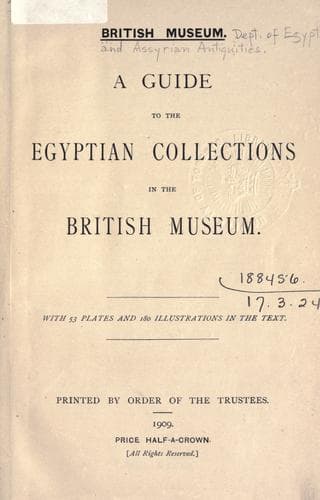
A guide to the Egyptian collections in the British MuseumBritish Museum. Department of Egyptian and Assyrian Antiquities
History
A guide to the Egyptian collections in the British Museum
British Museum. Department of Egyptian and Assyrian Antiquities
Egypt -- Antiquities
official, and his wife in Bay 18, No. =565= (see =Plate XXXVII=). This
monument is undoubtedly one of the most beautiful examples of Egyptian
sculpture in the British Museum. Here, too, must be noted a very rare
object, viz., a =complete wooden door=, from the tomb of =Khensu-ḥetep=
at Thebes, on which is cut a scene representing the deceased making
offerings to Osiris-Khenti-Ȧmenti, in the presence of Hathor, lady of
Ȧmentet (Vestibule, North Wall, No. =566=).
Nineteenth Dynasty. From Thebes.
_About_ B.C. 1370.
=Rameses I=, the first king of this dynasty, appears to have ascended
the throne when he was an elderly man. He made an attempt to enter into
friendly relations with Sapalul, the chief of the Kheta, or Hittites;
and he seems to have raided the Sûdân. Monuments of his reign are few
(see the =scarabs= inscribed with his name in Table-case D in the Fourth
Egyptian Room).
The early years of the reign of =Seti I=, the son and successor of
Rameses I, were spent in fighting. He attacked the Shasu, or nomad tribes
of the Eastern Desert and of Palestine and Syria, and defeated them with
great slaughter, and advanced to the city of Kadesh, on the Orontes,
and conquered it. He returned to Egypt laden with spoil, including cedar
wood from Lebanon for making a new barge for Ȧmen-Rā at Thebes. He made
raids in the Sûdân, and forced the natives to assist him in reworking
the old gold mines and opening up new ones. He reopened the copper mines
in Sinai, and all the large quarries, for he needed much stone for his
buildings. He began to build a great temple at Abydos, but did not live
to finish it: the walls and pillars are ornamented with religious scenes
and figures of the gods, and the sculptures and reliefs are among the
most beautiful of Egypt. In one of the corridors is the famous King
List, or =Tablet of Abydos=, which contains the names of 76 kings, the
first name being that of Menȧ or Menes. At Karnak he added 79 columns to
the =Hall of Columns= (see =Plate XXX=); at Ḳurnah (Thebes) he finished
the temple begun by his father Rameses I; and he built a splendid tomb
in the Valley of the Tombs of the Kings (see page 174). From this tomb
came his magnificent alabaster =sarcophagus= which is now preserved in
Sir John Soane’s Museum in Lincoln’s Inn Fields. Seti I built a temple
at Dulgo, near the Third Cataract, probably in connexion with the gold
trade carried on by the government; he opened up roads to the gold
deposits in the Wâdî Ulâḳî, in the Eastern Desert; and he built a temple
at Radassîyah on the old caravan road which ran from Edfû to the emerald
mines of Gebel Zâbarâ, near Berenice, on the Red Sea; and dug wells at
many places in the desert. His reign was comparatively short, 10 or 15
years at most, and he was succeeded by his second son Rameses II, whom he
had made co-regent. Among the monuments of his reign are: Large =wooden
Ka-figure of Seti I=, found in a chamber in his tomb (Central Saloon, No.
Public-domain text, read in full here on John Shaqi.
Reviews
Reviews
No reviews yet
Be the first to share your thoughts on this work.
Elsewhere in the archive
Join the Discussion
Join the discussion
Sign in to leave a comment or review.
Sign InorCreate an account