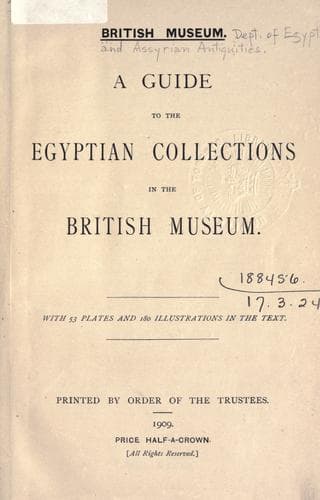
A guide to the Egyptian collections in the British MuseumBritish Museum. Department of Egyptian and Assyrian Antiquities
History
A guide to the Egyptian collections in the British Museum
British Museum. Department of Egyptian and Assyrian Antiquities
Egypt -- Antiquities
We learn from the great papyrus of Rameses III that after the downfall of
the XIXth dynasty the land of Egypt fell into a state of anarchy, every
man acting according to his own judgment, and no one holding supreme
authority for many years. The country was in the hands of the nobles and
the governors of the cities who fought against each other. This continued
for some years, and then “years of want” succeeded, and a certain Syrian
called =Ȧrsu= 𓇋𓀀𓁹𓂋𓇓𓏲𓌙𓀀, rose to power. Gathering his followers about
him, he levied tribute and seized the goods of the people. As he paid
no honour to the gods of Egypt and did nothing for their temples, they
in due course set him aside and placed on the throne =Set-nekht=, who
brought the country into order, and re-established the worship of the
gods, and provided the temples with offerings. His reign was short,
and he was succeeded by =Rameses III=, the chief event of whose reign
of 31 years was the victory of the Egyptians over a confederation of
peoples from Philistia, Cyprus, Crete, and the northern shores of the
Mediterranean, who attacked Egypt by land and sea. Rameses III collected
an army and a fleet, and in the battle which followed on the coast of
Southern Palestine, his forces were victorious. Multitudes of the enemy
were slain on land, and those who succeeded in reaching their ships
could not escape, for the fleet of the Egyptians hemmed them in, and a
great slaughter ensued. Rameses then marched through Syria, and having
collected much spoil, returned to Egypt. Soon afterwards the Libyans
attacked Egypt on the west, but they were quickly defeated and spoiled.
Rameses appears to have kept one fleet in the Mediterranean and one in
the Red Sea, for trading purposes, and this “sea-power” was probably
the source of the great material prosperity of Egypt under his reign.
The peace and security of the country were such that he could boast:
“I made it possible for an Egyptian woman to walk with a bold and free
step whithersoever she pleased, and no man or woman among the people
of the land would molest her.” Rameses built the so-called “Pavilion”
and the great Temple of Madînat Habû at Thebes, and a small palace at
Tell al-Yahûdîyyah (see the glazed tiles, etc., from it in the Fourth
Egyptian Room), and he richly endowed the temples of Heliopolis, Memphis,
and Thebes, and gave them gifts of an almost incredible amount.[38] Lists
of all his benefactions and a valuable summary of his reign are preserved
in the great =Papyrus of Rameses III=, the longest Egyptian papyrus in
the world (see page 74). Among the monuments and small objects bearing
his name may be mentioned: The base of a pillar from a =shrine of Rameses
III= (Bay 18, No. =716=); a slab from one of his buildings at Ṣaḳḳârah
(Central Saloon, No. =717=); and the royal =ushabtiu= figures (Wall-case
85, Second Egyptian Room, Nos. 12, 13).
Public-domain text, read in full here on John Shaqi.
Reviews
Reviews
No reviews yet
Be the first to share your thoughts on this work.
Elsewhere in the archive
Join the Discussion
Join the discussion
Sign in to leave a comment or review.
Sign InorCreate an account