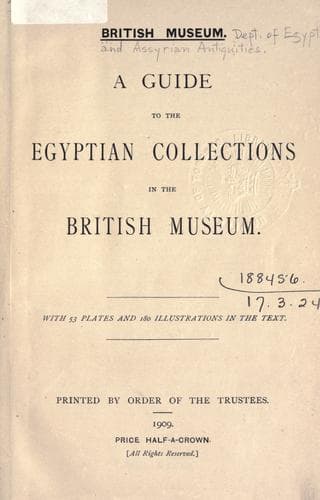
A guide to the Egyptian collections in the British MuseumBritish Museum. Department of Egyptian and Assyrian Antiquities
History
A guide to the Egyptian collections in the British Museum
British Museum. Department of Egyptian and Assyrian Antiquities
Egypt -- Antiquities
On the death of Rameses III the power of Egypt began rapidly to decline,
and the succeeding kings of the dynasty, each of whom bore the name of
Rameses, found their authority more and more usurped by the high-priests
of Ȧmen, the great god of Thebes. Among the objects inscribed with the
name of =Rameses IV= are =scarabs= (Table-case D, Fourth Egyptian Room),
a fragment of an =alabaster vase= (Wall-case 137, same room), and the
stele of =Ḥeru-ȧ=, a royal scribe (Bay 24, No. =719=).
Under the rule of =Rameses V-VIII= the people of Thebes became poor,
and the living were driven to plunder the tombs of kings and queens for
the sake of the gold ornaments on the mummies and in the coffins. Under
=Rameses IX= the government undertook a prosecution of the principal
thieves, and appointed a commission to report upon the extent of the
=robberies of the royal tombs=. Part of the statement of the examination
of the tombs is preserved in the Abbott Papyrus in the British Museum
(No. 10,221). During the course of the enquiry a number of the accused
were beaten on the hands and feet, and confessed to breaking into the
tombs of Sebek-em-sa-f and queen Nub-khā-s. In the reign of Rameses IX,
the =high-priest of Ȧmen=, called =Ȧmen-ḥetep=, held great power, and
induced the king to authorize him to levy taxes on the people for the
maintenance of his temple and priesthood. Under =Rameses X= further
prosecutions of the tomb robbers took place, but the government was
powerless to stop the depredations. =Rameses XI= and =Rameses XII= were
weaker than their predecessors, and allowed the high-priest of Ȧmen
to rule the country. On the death of Rameses XII, the high-priest,
=Ḥer-Ḥeru=, seized the supreme power, and assumed all the titles and
functions of the king of Egypt. But the priests of Ȧmen were as little
able to maintain the power of Egypt as the kings Rameses, and they could
not make their authority effective even in the Delta, or Northern Egypt.
Thus it fell out that Egypt became once more divided into two kingdoms,
viz., the Kingdom of the North, ruled from Tanis by =Nessu-ba-neb-Ṭeṭ=,
whose name was Graecized by Manetho under the form of =Smendes=, and the
Kingdom of the South, ruled from Thebes by =Ḥer-Ḥeru=, the first of the
=priest-kings= of Egypt. For some years, however, Smendes must have been
king of all Egypt, for when repairs of an urgent character were needed
for the temples of Thebes, it was he who had the quarries opened, and
collected the workmen, and directed the building operations which saved
one of the temples from falling down.
Public-domain text, read in full here on John Shaqi.
Reviews
Reviews
No reviews yet
Be the first to share your thoughts on this work.
Elsewhere in the archive
Join the Discussion
Join the discussion
Sign in to leave a comment or review.
Sign InorCreate an account