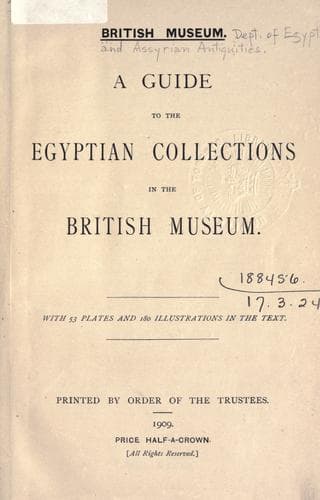
A guide to the Egyptian collections in the British MuseumBritish Museum. Department of Egyptian and Assyrian Antiquities
History
A guide to the Egyptian collections in the British Museum
British Museum. Department of Egyptian and Assyrian Antiquities
Egypt -- Antiquities
The monuments of the XXth dynasty are characterized by coarseness of work
and lack of finish, but the inscriptions on them are of considerable
value linguistically. Among large objects may be mentioned the =granite
coffin of Setau=, a governor of the Sûdân (Bay 19, No. =720=); the
=libation basin= (Bay 19, No. =722=); the seated figures of =Ȧmen-Rā and
Mut= (Bay 18, No. =728=); the stele of =Pai=, comptroller of a chief
queen (Bay 22, No. =752=); and the shrine of =Ȧmen-em-ḥeb=, a scribe of
the king’s bowmen (Bay 17, No. =754=).
Twenty-First Dynasty.
B.C. 1050 (?)
KINGS OF TANIS.
=Nessu-ba-neb-Ṭeṭ (Smendes).=
=Pasebkhānut I.=
=Ȧmen-em-Ȧpt.=
=Sa-Ȧmen.=
=Pasebkhānut II.=
PRIEST-KINGS OF THEBES.
=Ḥer-Ḥeru.=
=Paiānkh.=
=Painetchem I.=
=Painetchem II.=
=Masaherth.=
=Men-kheper-Rā.=
=Painetchem III.=
The reigns of all these kings are historically of little importance. As
soon as =Ḥer-Ḥeru= had proclaimed himself king at Thebes, he assumed a
series of titles indicating that he was the temporal as well as spiritual
head of Egypt. One of the chief works carried out by the priest-kings
was in connexion with the repair and =removal of the royal mummies=
from their tombs to places of safety. The mummies of Seti I and Rameses
II were removed from tomb to tomb, but the pillaging continued, and we
read that many of the royal mummies required to be repaired, re-swathed,
and provided with new coffins. The rule of the priest-kings was not
successful, and several serious riots seem to have occurred at Thebes
through their neglect of the temporal affairs of the country. One of
the most important objects of the reign of Ḥer-Ḥeru is the copy of the
=Book of the Dead= which was written for his wife =Queen Netchemet=;
an important portion of it was presented to the British Museum by
HIS MAJESTY THE KING in 1903, and this is exhibited in the Southern
Egyptian Gallery, No. =758= (see =Plates I= and =XLI=). The vignettes
are very fine examples of the work of the period, and the texts contain
interesting hymns to Rā and Osiris, and a valuable version of one of the
most important sections of the Book of the Dead, viz., Chapter XVII. This
papyrus was found at Thebes. A number of =ushabtiu= figures, inscribed
with the names of =Nesi-Khensu=, =Ḥent-taui=, the =Painetchems=,
=Maāt-ka-Rā=, and other members of the families of the priest-kings,
will be found in Wall-cases 153, 154, in the Fourth Egyptian Room. The
largest monument of this dynasty in the British Museum is a =lintel= from
a temple of =Sa-Ȧmen= at Memphis (No. =1170=). In the First Egyptian Room
are exhibited several very fine mummies and coffins belonging to the
period of this dynasty, and in the Second Room several typical examples
of =ushabtiu figures= and =boxes=, which illustrate the funerary art of
the period. The monuments of the Tanite kings are few and unimportant.
Public-domain text, read in full here on John Shaqi.
Reviews
Reviews
No reviews yet
Be the first to share your thoughts on this work.
Elsewhere in the archive
Join the Discussion
Join the discussion
Sign in to leave a comment or review.
Sign InorCreate an account