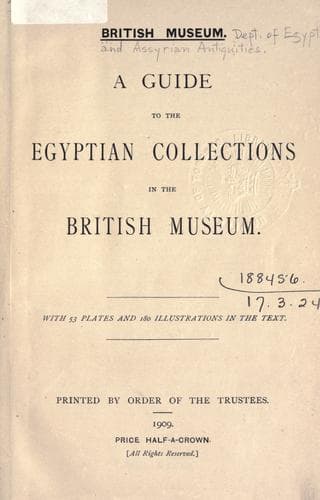
A guide to the Egyptian collections in the British MuseumBritish Museum. Department of Egyptian and Assyrian Antiquities
History
A guide to the Egyptian collections in the British Museum
British Museum. Department of Egyptian and Assyrian Antiquities
Egypt -- Antiquities
The successor of Taharqa was =Tanuath Ȧmen=, the Tandamanie of the
cuneiform inscriptions, who had been co-regent with him. After the death
of Taharqa, as the result of a dream Tanuath Ȧmen invaded Egypt, and
captured Heliopolis; he tried to turn the Assyrians out of Memphis, but
failed. Hearing that the king of Assyria was coming with a large army, he
fled to Thebes, whither he was followed by the Assyrians, who sacked the
city. Tanuath-Ȧmen fled once more, and his subsequent history is unknown.
A cast of the =Stele of the Dream= is exhibited in Bay 22, No. =799=, and
an account of the burning and pillage of Thebes is given on the great
=cylinder of Ashur-bani-pal= (Table-case H, Babylonian Room), and the
calamities which came upon the city are described by the prophet Nahum
(iii, 10).
Twenty-Sixth Dynasty. From Saïs.
_About_ B.C. 666.
=Psemthek I=, or =Psammetichus=, was the son of Nekau, governor of
Saïs, and married Shep-en-Ȧpt, the daughter of Piānkhi and Ȧmenȧrṭās
I. Thus, by marriage, he obtained a claim to the throne of Egypt. He
appears to have fought against the Assyrians on every opportunity for
many years, and at length by the help of Carian and Ionian mercenaries
he succeeded in expelling them, and in making himself master of all
Egypt. He established garrisons at Elephantine, Pelusium, Daphnae, and
Marea. He protected the Greeks, a colony of whom he settled in the city
of Naukratis. He encouraged trade of every kind, and embarked in many
commercial enterprises. He rebuilt, or enlarged, the temple of the
goddess =Neith of Saïs= (see bronze figures of her in Wall-case 125,
Fourth Egyptian Room), and built a gallery in the =Serapeum= at Ṣaḳḳârah.
Among the monuments of his reign are: An =intercolumnar slab= sculptured
with a scene representing the king making an offering to the gods; from
the temple of Temu at Rosetta (Bay 24, No. =800=). A shaft of a column,
and a portion of a statue, inscribed with his names and titles (Bay 24,
Nos. =801=, =802=). For smaller objects inscribed with his name see the
=Foundation Deposits= and the =figure of Isis= (Table-cases K and H,
Third Egyptian Room), his =ushabti figure= (Wall-case 78, Second Egyptian
Room), and his =scarabs= (Table-case D, Fourth Egyptian Room).
[Sidenote: B.C. 612.]
Public-domain text, read in full here on John Shaqi.
Reviews
Reviews
No reviews yet
Be the first to share your thoughts on this work.
Elsewhere in the archive
Join the Discussion
Join the discussion
Sign in to leave a comment or review.
Sign InorCreate an account