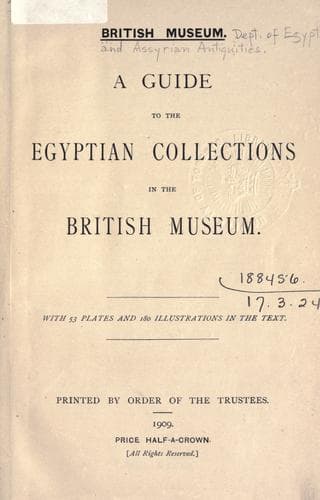
A guide to the Egyptian collections in the British MuseumBritish Museum. Department of Egyptian and Assyrian Antiquities
History
A guide to the Egyptian collections in the British Museum
British Museum. Department of Egyptian and Assyrian Antiquities
Egypt -- Antiquities
=Shabaka=, or Sabaco, whom some identify with =So= of 2 Kings xvii, 4,
was a contemporary of Sargon and Sennacherib, kings of Assyria. With
one or other of these kings he must have had correspondence, for two
seals bearing the name of Shabaka were found among the tablets of the
Royal Library at Nineveh. (See Nineveh Gallery, Table-case I, No. 32,
etc.) Among the objects bearing his name are several =scarabs=, and an
alabaster =vase= in the Fourth Egyptian Room (Table-case D and Wall-case
139), and a basalt slab (Bay 25, No. =797=) inscribed with a copy of
a mythological text, copied by the king’s order from an old, half
obliterated document. The portion of the text surviving contains legends
of Rā, Osiris, Set, Horus, Ptaḥ and other gods; and it seems to imply
that all their powers were absorbed by Ptaḥ, in whose temple the slab
was set up. Of Shabaka’s sister, the great Princess =Ȧmenȧrṭās=, may be
mentioned the following objects: A fine inscribed =statue= (Wall-case
107, Third Egyptian Room), her =lapis-lazuli scarab= (Table-case D,
Fourth Egyptian Room), and a =steatite cylinder= inscribed with her names
and titles (Wall-case 193, same room). This princess possessed great
power in Thebes, and she repaired portions of some of the great temples
of that city, and built a small chapel near the temple of Ȧmen. She
re-established the worship of the gods, and devoted a large proportion of
her property to the restoration of their statues and the observance of
their festivals.
Shabaka was succeeded by =Shabataka= (see a bronze shrine dedicated by
him to Ȧmen-Rā in Wall-case 123 in the Fourth Egyptian Room), of whom
little is known. He was followed by =Taharqa=, the =Tirhâḳâh= of the
Bible, (2 Kings xix, 9), the son of a farmer and the lady =Āqleq=, who
began to reign between B.C. 693 and 691. He was an ally of =Hezekiah=,
king of Judah. About 676, =Esarhaddon=, king of Assyria, crushed the
revolt in Palestine, and six years later he invaded Egypt, defeated
Taharqa, captured Memphis, and appointed twenty governors over the
various provinces of the country. After the death of Esarhaddon, in
668, Taharqa returned and proclaimed himself king of Egypt at Memphis;
but =Ashur-bani-pal=, the new king of Assyria, marched against him and
defeated his forces, which were assembled at Karbaniti, a city probably
situated near the north-east frontier of Egypt. Taharqa fled, and
Ashur-bani-pal marched into Egypt, crushed the enemy, and re-appointed
the governors who had been appointed by his father.
Taharqa repaired several temples at Thebes, and built a large temple to
Ȧmen at Napata, and a small one in honour of Usertsen III at Semnah. For
a bronze =figure of the king=, and two =plaques= and =scarabs= bearing
his name, see Table-case K, Wall-case 193, and Table-case D in the Third
and Fourth Egyptian Rooms.
Public-domain text, read in full here on John Shaqi.
Reviews
Reviews
No reviews yet
Be the first to share your thoughts on this work.
Elsewhere in the archive
Join the Discussion
Join the discussion
Sign in to leave a comment or review.
Sign InorCreate an account