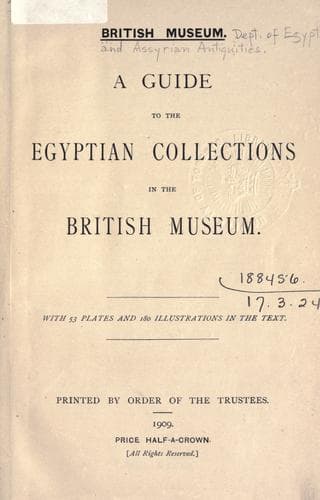
A guide to the Egyptian collections in the British MuseumBritish Museum. Department of Egyptian and Assyrian Antiquities
History
A guide to the Egyptian collections in the British Museum
British Museum. Department of Egyptian and Assyrian Antiquities
Egypt -- Antiquities
=Amāsis II= treated his former master with kindness, but, as Ḥophra
persisted in raiding the country, further fighting ensued. In the end,
Ḥophra was slain by his own soldiers on board his boat. During the reign
of Amāsis II Nebuchadnezzar II attempted to invade Egypt, with what
success is unknown. During this long reign of about 44 years the country
in general enjoyed peace and prosperity, and the quarries were re-opened
and many temples restored; remains of his building activity are visible
on the sites of all the great sanctuaries of Egypt. He was a generous
patron of the Greeks, and granted them lands and many privileges. Among
the monuments of his reign are: Two granite tablets for offerings, or
=altars= (Bay 16, No. =806=; Bay 17, No. =807=); a stele, dated in his
eighth year, recording the dedication of a building to Neith, goddess
of Saïs (Bay 24, No. =808=); a =weight= inscribed with his prenomen
(Wall-case 180, Fourth Egyptian Room), and handles of two =sistra=
(Wall-case 187, same room).
Amāsis II married Thent-kheta, by whom he became the father of
Psammetichus III. He was also the official husband of the famous
high-priestess of Ȧmen, =Ānkhnes-neferȧb-Rā=, the daughter of
Psammetichus II and the Lady =Takhauath=, and the adopted daughter
of Nit-Ȧqert (Nitokris), high priestess of Ȧmen.[39] The magnificent
=sarcophagus= in the Southern Egyptian Gallery was made for her (Bay
24, No. =811=). It is undoubtedly one of the finest monuments of the
XXVIth dynasty in the British Museum. (See =Plates XLIII=, =XLIV=).
The reliefs and figures are carefully executed, and the hieroglyphics
are well cut. In the Ptolemaïc Period this sarcophagus was used for a
royal scribe named Ȧmen-ḥetep, or Pi-Menth, his name being inserted in
the cartouches and the feminine suffixes being changed to masculine.
Ānkhnes-neferȧb-Rā built a chapel at Thebes, from which came slabs
Nos. =812=, =813= (Bay 24). Worthy of note also are two fine bronze
figures of =Harpokrates-Ȧmen= and =Menu=, which were dedicated to Queen
Ānkhnes-neferȧb-Rā by priests in her temple (see Table-case H, Third
Egyptian Room). Amāsis II had a daughter, =Ta-Khart-Ȧst= (for a portion
of a statue of her see Bay 24, No. =814=).
[Illustration: PLATE XLIII.
Queen Ānkhnes-neferȧb-Rā, daughter of Psammetichus II and Queen
Takhauath, wearing the head-dress of Isis-Hathor. From the cover of the
sarcophagus of the queen.
About B.C. 600.
[Southern Egyptian Gallery, Bay 24, No. 811.]]
[Illustration: PLATE XLIV.
The Sky-goddess Nut. From the inside of the sarcophagus of Queen
Ānkhnes-neferȧb-Rā.
[Southern Egyptian Gallery, Bay 24, No. 811.]]
[Illustration: PLATE XLV.
Kneeling statue of Uaḥ-ȧb-Rā, a prince, governor, and commander-in-chief,
about B.C. 600.
XXVIth dynasty.
[Southern Egyptian Gallery, Bay 21, No. 818.]]
Public-domain text, read in full here on John Shaqi.
Reviews
Reviews
No reviews yet
Be the first to share your thoughts on this work.
Elsewhere in the archive
Join the Discussion
Join the discussion
Sign in to leave a comment or review.
Sign InorCreate an account