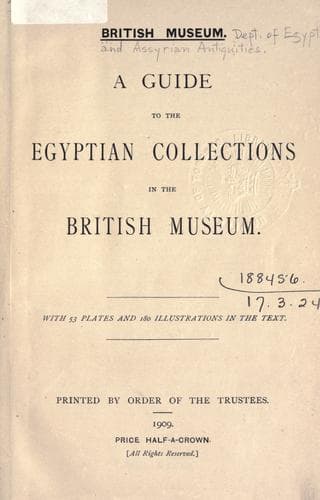
A guide to the Egyptian collections in the British MuseumBritish Museum. Department of Egyptian and Assyrian Antiquities
History
A guide to the Egyptian collections in the British Museum
British Museum. Department of Egyptian and Assyrian Antiquities
Egypt -- Antiquities
The last king of this dynasty was =Psammetichus III=. During his short
reign, which lasted six months only, the Persians under their king
Cambyses invaded Egypt, and, having defeated the Egyptians at Pelusium,
marched on to Memphis and captured it. After a short time Cambyses put
Psammetichus to death, and =Egypt became a province=, or satrapy, of
=Persia=.
During the rule of the XXVIth dynasty over Egypt, it appears that several
native Nubian kings ruled the Northern Sûdân from Napata, the modern
Gebel Barkal. Among these were =Ȧspelta= and =Ḥeru-sa-ȧtef=, the former
of whom probably reigned about B.C. 625 and the latter about B.C. 580.
For casts of stelae recording the =Coronation of Ȧspelta= and the Annals
of =Ḥeru-sa-ȧtef=, see Bay 18, No. =815=, and Bay 20, No. =816=. A cast
of a stele inscribed with an edict against the =eaters of raw meat= is in
Bay 20, No. =817=.
Under the XXVIth dynasty a great =revival of art and learning= took
place, due partly to the settled condition of the country under a firm
government, and partly to the material prosperity which obtained at that
period. The painter and sculptor took for their models the reliefs and
statues of the Early Empire, and the funerary masons and scribes cut or
wrote on the stelae and tombs texts which were composed under the VIth
dynasty, or earlier. The monuments of the period are more often made
of dark limestone, dark green or grey schist, and basalt than granite,
which was so commonly used for coffins, statues, stelae, etc., under the
Middle Empire. These substances give to the large monuments of the =Saïte
Period= a sad and sometimes heavy effect. Among the many fine examples
of the sculpture of the period may be mentioned: The black basalt
kneeling statue of =Uaḥ-ȧb-Rā=, a prince and general of the army (see
=Plate XLV=; Bay 21, No. =818=); the portion of the kneeling figure of
=Khnem-ȧb-Rā-Men=, prefect of Saïs, holding a =shrine of Neith= (Bay 23,
No. =819=); the portion of a figure of =Ānkh-p-kharṭ=, a priest who had
ministered in the temple for eighty years (Bay 24, No. =820=); and the
=libation bowl= dedicated to the goddesses Mut and Hathor (Bay 22, Nos.
=821=, =822=). The casts of the =Cow= of Hathor and the =Hippopotamus=
of Smeṭsmeṭ are also very instructive (Bay 25, No. =823=; Bay 26, No.
=824=). Of the massive stone =sarcophagi= and coffins, Nos. =825-829=
are very fine important examples. On the two granite sarcophagi of
=Nes-Qeṭiu= (No. =825=) and =Ḥāp-men= (No. =826=) are cut the figures
of all the gods who were believed to protect the dead; but the others
(Nos. =827-29=) are plainer. The sepulchral stelae are very numerous;
interesting examples will be found in Bays 21, 22, etc.
Twenty-Seventh Dynasty. From Persia.
B.C. 527.
Public-domain text, read in full here on John Shaqi.
Reviews
Reviews
No reviews yet
Be the first to share your thoughts on this work.
Elsewhere in the archive
Join the Discussion
Join the discussion
Sign in to leave a comment or review.
Sign InorCreate an account