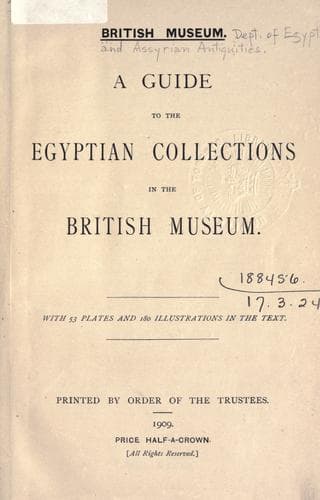
A guide to the Egyptian collections in the British MuseumBritish Museum. Department of Egyptian and Assyrian Antiquities
History
A guide to the Egyptian collections in the British Museum
British Museum. Department of Egyptian and Assyrian Antiquities
Egypt -- Antiquities
In the reign of =Artaxerxes I= another revolt, headed by =Inarôs=, a
Libyan, who was assisted by the Athenians, broke out, and at the battle
of Papremis, the satrap of Egypt, =Akhaemenes=, was killed and his forces
defeated. Subsequently the Persians defeated the Egyptians, and =Inarôs=
was captured and taken to Persia, where a few years later he was impaled
and flayed alive.
[Sidenote: B.C. 424.]
=Darius II, Nothus=, repaired the temple of Ȧmen-Rā at Al-Khârgah,
and added his name to its walls. In his reign the Egyptians at length
succeeded in throwing off the Persian yoke. Their leader, =Amyrtaios=,
has been thought to be Ȧmen-ruṭ-meri-Ȧmen.
Twenty-Eighth Dynasty. From Saïs.
B.C. 420 (?).
According to the King List of Manetho the XXVIIIth dynasty consisted of
one king, who was named =Amyrtaios=; Julius Africanus and the Syncellus
state that he reigned six years, and make Saïs the seat of his rule.
At one time authorities identified Amyrtaios with the king =Ȧmen-ruṭ=,
whose name 𓊹𓄤𓍹𓇳𓄊𓌷𓏏𓇋𓏠𓈖𓍉𓈖𓍺𓎟𓇾𓇾𓍹𓇋𓏠𓈖𓌗𓇋𓏠𓈖𓌻𓍺 is found on a plank
from a coffin preserved at Berlin. The form of the prenomen, however,
proves that Ȧmen-ruṭ lived at a period anterior to Amyrtaios, and the
identification must, therefore, be abandoned.
Twenty-Ninth Dynasty. From Mendes.
B.C. 399.
Of the five kings of this dynasty only three appear to have left remains,
viz. =Naifaauruṭ= (Nepherites), =Haḳer= (Achoris), and =Psamut=; their
reigns were unimportant, their total length being only about twenty-one
years.
Thirtieth Dynasty. From Sebennytus.
B.C. 378.
[Sidenote: B.C. 378.]
=Nekht-Ḥeru-ḥebt=, the Nektanebês and Nektanebus I of classical writers,
succeeded in overthrowing the dynasty of Mendes, and made himself king of
all Egypt, which he ruled with success for a period of eighteen years. He
repaired several of the temples of Memphis and Thebes, and the temple of
Darius I at Al-Khârgah, and revived the custom of setting up obelisks. He
also founded the temple of Horus at Ḥebt, the modern Behbît-al-Ḥagârah.
During his prosperous reign more attention was given to the performance
of ceremonies connected with the dead, and, as a result, a considerable
number of statues, stelae, etc., which may be attributed to his reign
have come down to us.
[Illustration: PLATE XLVI.
Obelisk dedicated to Thoth by King Ḥeru-nekht-ḥebt, B.C. 378.
XXXth dynasty.
[Southern Egyptian Gallery, Bay 31, No. 919.]]
[Illustration: PLATE XLVII.
Scenes and texts from the Second Section of the Book of What is in the
Other World. From the sarcophagus of King Nekht-Ḥeru-ḥebt, B.C. 378.
[Southern Egyptian Gallery, Bay 25, No. 923.]]
Public-domain text, read in full here on John Shaqi.
Reviews
Reviews
No reviews yet
Be the first to share your thoughts on this work.
Elsewhere in the archive
Join the Discussion
Join the discussion
Sign in to leave a comment or review.
Sign InorCreate an account