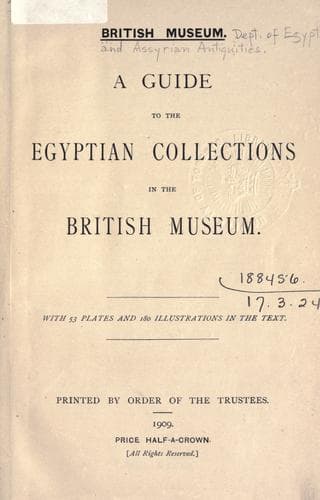
A guide to the Egyptian collections in the British MuseumBritish Museum. Department of Egyptian and Assyrian Antiquities
History
A guide to the Egyptian collections in the British Museum
British Museum. Department of Egyptian and Assyrian Antiquities
Egypt -- Antiquities
The rule of the Persians over Egypt lasted about one hundred and ten
years. =Cambyses=, having established himself as king, set out on an
expedition to the Sûdân. On his way thither he despatched an army of
50,000 men to the Oasis of Jupiter Ammon, now known as Sîwah, to secure
the submission of the tribes; but, after reaching Khârgah, these troops
were never more heard of. Cambyses continued his march into Nubia, where,
it seems, he came in touch with a native army somewhere near the Third
Cataract. According to the annals of =Nȧstasen=, king of Nubia, his boats
were captured on the river, and all his soldiers slain after a fierce
fight. Greek tradition states that Cambyses committed many sacrilegious
acts in Egypt; but the inscription of Utcha-ḥer-resenet, the chancellor
of Saïs, records that Cambyses cleared out the temple of Neith in that
city, restored its revenues, and reinstated its priests. This done he
went to the temple in person, and performed acts of worship, like the
Pharaohs of old. The money which he gave the chancellor enabled him “to
provide with a coffin the man who was too poor to buy one, and he took
care of the children.”
[Sidenote: B.C. 521.]
=Darius I, Hystaspes=, was a wise and enlightened king, and he tried to
understand the religion and customs of the Egyptians. He established a
=coinage=, encouraged trade, subscribed money for expenses incurred in
the discovery of a new =Apis Bull=, supported religious institutions, and
commissioned the chancellor Utcha-ḥer-resenet to found a school for the
training of scribes. He was tolerant; and built a temple to Ȧmen-Rā in
the Oasis of Al-Khârgah, on the walls of which is cut a remarkable hymn
to Ȧmen. He also completed the canal between the Nile and the Red Sea,
which Necho began, and so added greatly to the prosperity of the country.
In the latter part of his reign the Egyptians, led by =Khabbesha=,
revolted against the Persian rule with some success. Darius determined to
set out from Persia to put down the rebellion, but died before he could
do so. The triumph of Khabbesha was short-lived, for =Xerxes the Great=
marched against him, defeated his forces, and reduced the country to
servitude worse than before. Xerxes did nothing for the gods or people
of Egypt, and left few traces of his reign in the country. An =alabaster
vase= inscribed with his name in four languages, Egyptian, Persian,
Median and Babylonian, which was found at Halicarnassus, is exhibited in
the =Gold Room= in the British Museum. For fragments of other vases, on
which his name appears in Egyptian letters, within a cartouche, and with
the additions “Pharaoh, the Great,” as here given, see Wall-cases Nos. 28
and 29, in the Babylonian Room. A cast of a stele, dated in his fourth
year, with a bilingual inscription in Egyptian and Aramean, is exhibited
in the Semitic Room (Second Northern Gallery, Wall-case 29).
𓍹𓆼𓆷𓇌𓄿𓃭𓆷𓄿𓍺𓉐𓉻𓅮𓉻𓂝
[Sidenote: B.C. 486.]
[Sidenote: B.C. 466.]
Public-domain text, read in full here on John Shaqi.
Reviews
Reviews
No reviews yet
Be the first to share your thoughts on this work.
Elsewhere in the archive
Join the Discussion
Join the discussion
Sign in to leave a comment or review.
Sign InorCreate an account