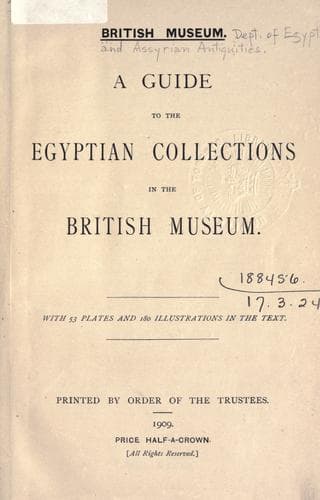
A guide to the Egyptian collections in the British MuseumBritish Museum. Department of Egyptian and Assyrian Antiquities
History
A guide to the Egyptian collections in the British Museum
British Museum. Department of Egyptian and Assyrian Antiquities
Egypt -- Antiquities
Nearly all the Roman emperors from Tiberius (A.D. 14) to Decius (A.D.
249) adopted Egyptian names and titles, and caused their names to be
written within cartouches like those of the Pharaohs. The stele in Bay
27 (No. =1052=) states that =Tiberius= rebuilt portions of the temple of
Mut at Thebes (see =Plate LI=); and another stele (Bay 29, No. =1053=)
refers to the setting up by him of a statue of the goddess Mut, and the
re-endowment of the portion of the temple wherein it stood (see =Plate
LII=). In the reign of =Nero= (A.D. 54-69) two centurions sent into the
Sûdân to report on the general condition of the country reached the
marshes near Shâmbî, about 700 miles south of Kharṭûm. Tradition asserts
that =Christianity= was preached in Alexandria towards the close of
his reign, and that =St. Mark= arrived in that city, A.D. 69. To this
period belongs stele No. =1057= (Bay 32), which was set up to mark the
gratitude of the Egyptians to Nero for appointing F. Claudius Balbillus,
prefect of Egypt. =Hadrian= visited Egypt twice, and founded the city
of Antinoopolis in memory of his friend Antinous who was drowned in
the Nile; when at Thebes he went with the Empress Sabina to view the
=Colossi= (see =Plate XXXIII=). =Marcus Aurelius= (A.D. 161-180) was a
just ruler and favoured Christianity in Egypt; in his reign the walls
which surrounded the Sphinx at Gîzah were repaired (see stele, No.
=1058=, Bay 32). =Septimius Severus= (A.D. 196) issued an edict against
the Christians in Egypt, and his successor, =Caracalla= (A.D. 211),
encouraged the pagan Egyptians and favoured their religion. =Decius=
(A.D. 249) made a systematic attempt to destroy the Christians, and every
person was called upon to offer sacrifice to the gods, or suffer death.
In the reign of =Diocletian= (A.D. 284), the =Blemmyes=, a confederation
of tribes who lived in the Eastern Sûdân, became so powerful that they
compelled the Roman garrisons to withdraw from the =Dodekaschoinos=,[41]
and the emperor was obliged to hire the =Nobadae=, or tribes of the
Western Desert, to keep them in check. He also agreed to pay the Blemmyes
a fixed annual sum to refrain from raiding Roman territory in Egypt,
and built a temple at Elephantine wherein representatives of all the
peoples concerned might swear to observe the covenant in the presence
of their respective gods. Diocletian in fact abandoned the Sûdân. In
304 he issued a savage =edict against the Christians= in Egypt, and
the persecution which followed it was marked with ferocious cruelty.
Many thousands of Egyptians fled to the desert monasteries to avoid
conscription, and embraced Christianity. From one of his buildings on
the Island of Philae comes the stone bearing the names of Diocletian and
=Constantine= (A.D. 324) (No. =1059=, Bay 26).
Public-domain text, read in full here on John Shaqi.
Reviews
Reviews
No reviews yet
Be the first to share your thoughts on this work.
Elsewhere in the archive
Join the Discussion
Join the discussion
Sign in to leave a comment or review.
Sign InorCreate an account