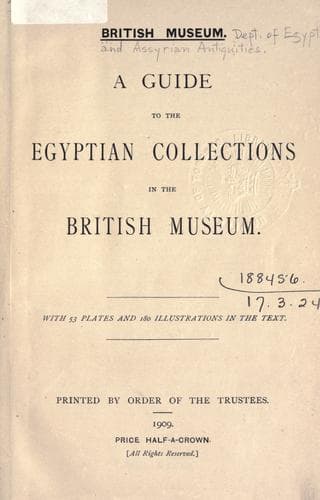
A guide to the Egyptian collections in the British MuseumBritish Museum. Department of Egyptian and Assyrian Antiquities
History
A guide to the Egyptian collections in the British Museum
British Museum. Department of Egyptian and Assyrian Antiquities
Egypt -- Antiquities
In 378 =Theodosius the Great= proclaimed Christianity the religion of
his Empire, and many temples in Lower Egypt were turned at once into
churches; but the ancient Egyptian gods were worshipped as usual in
Upper Egypt. =Marcianus= (A.D. 450-457) invaded Nubia and punished the
Blemmyes and Nobadae for raiding Roman territory; they paid a huge fine,
gave hostages for their future good behaviour, and made an agreement to
keep the peace for one hundred years. In return they stipulated that
they should be allowed to make pilgrimages annually to Philae, and to
borrow the statue of Isis from time to time, so that they might take it
about the country, and give the people the opportunity of invoking the
protection and blessing of the goddess. In the first half of the sixth
century the Nubians =embraced Christianity=, and =Silko=, king of the
Nobadae, founded a kingdom having its capital at Dongola. During the
reign of =Justinian= (A.D. 527-565) the hundred years’ truce came to an
end, and the Blemmyes and Nobadae again began to give trouble. Justinian,
believing that the cause of the revolt was the annual pilgrimage to
Philae, sent his officer Narses thither, with strict orders to close
the temples of Isis. Narses threw the priests of Isis into prison,
confiscated the revenues of the goddess, and carried off the statues of
the gods of Philae to Constantinople.
In the reign of =Heraclius= the Persians, under Chosroës, invaded Egypt
(A.D. 619), which they held for ten years. Owing to the desertion from
the Persians of the Arab tribes, who had now attached themselves to the
victorious troops of =Muḥammad the Prophet= (born at Mekkah, Aug. 20,
A.D. 570, died in June, 632), Heraclius was able to attack the Persians,
in Syria, and defeating them became master of Egypt once more. In =640=
=ʿAmr Ibn al-Âṣî=, the general of the Khalîfa Omar, conquered Egypt, and
thus the country became a province of the newly-founded Arab Empire.
Public-domain text, read in full here on John Shaqi.
Reviews
Reviews
No reviews yet
Be the first to share your thoughts on this work.
Elsewhere in the archive
Join the Discussion
Join the discussion
Sign in to leave a comment or review.
Sign InorCreate an account