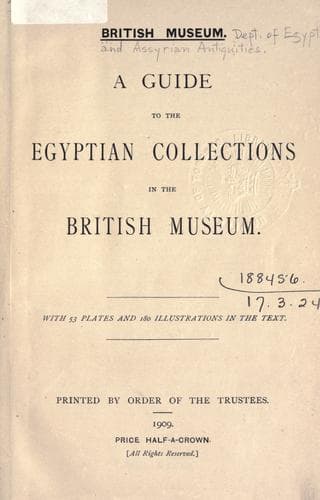
A guide to the Egyptian collections in the British MuseumBritish Museum. Department of Egyptian and Assyrian Antiquities
History
A guide to the Egyptian collections in the British Museum
British Museum. Department of Egyptian and Assyrian Antiquities
Egypt -- Antiquities
During the rule of the Romans, which lasted from B.C. 30 to A.D. 640, the
Greek language entirely superseded Egyptian for official purposes, and
it was also usually employed in the funerary inscriptions. Interesting
examples are the stele of =Politta=, inscribed with a metrical text (Bay
26, No. =1083=), and the stele of =Artemidorus= (Bay 26, No. =1084=).
On the =pillar altar= (Bay 31, No. =1086=) is a dedication in Greek to
the god Serapis of the city of Canopus; and on the square sandstone slab
(Bay 26, No. =1087=) is a very interesting but difficult text recording
the cleansing and restoration of some public building near the town of
Kom Ombo in Upper Egypt, whilst Gabriel was Duke of the Thebaïd. Other
interesting inscriptions in Greek are found in =ostraka=, or potsherds,
many of which are dated in the reigns of Claudius, Nero, Vespasian,
Trajan, Antoninus, Sabinus, Pertinax, etc., will be found exhibited in
Table-case C in the Third Egyptian Room. During the early centuries of
Roman rule the Egyptians continued to mummify their dead, and to bury
them with the ancient rites and ceremonies. The use of the funerary
stele or tablet continued down to the fourth century A.D.; but the gods
represented on them appeared in different forms, and Greek or demotic
took the place of hieroglyphics. In the region about Thebes and to the
south of that city the cult of Osiris and Isis continued until about A.D.
560, and a simple system of mummification was practised in connexion with
the worship of the dead.
[Illustration: Sepulchral tablet sculptured with figures of doves,
pillars, leaf patterns, etc.
[Southern Egyptian Gallery, Bay 30, No. 1156.]]
Public-domain text, read in full here on John Shaqi.
Reviews
Reviews
No reviews yet
Be the first to share your thoughts on this work.
Elsewhere in the archive
Join the Discussion
Join the discussion
Sign in to leave a comment or review.
Sign InorCreate an account