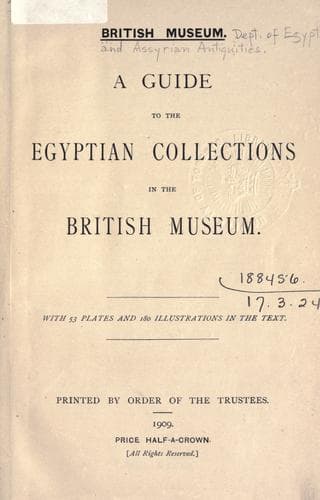
A guide to the Egyptian collections in the British MuseumBritish Museum. Department of Egyptian and Assyrian Antiquities
History
A guide to the Egyptian collections in the British Museum
British Museum. Department of Egyptian and Assyrian Antiquities
Egypt -- Antiquities
[27] The Coptic names are derived from the ancient Egyptian names; thus
“THOTH” is from 𓅝𓏏𓏭𓀭, whose festival was celebrated in that month.
“Choiak” is from the name of the festival _Ḳaḥrȧka_ 𓂓𓏤𓁷𓏤𓂓𓏤𓎱𓇳𓏦, and
so on.
[28] We should naturally expect 𓈚𓈗 to represent the whole period of the
Inundation, and not merely the first two or three weeks of it; and 𓆷𓏏𓇳
cannot originally have referred at all to the period of the Inundation.
This subject, however, is one of difficulty.
[29] A second =Tablet of Abydos=, made for Rameses II, is exhibited in
the Northern Egyptian Gallery, Bay 6, No. 592.
[30] To these may be added the fragment of a stele (now preserved at
Palermo), from which the names of a few of the Predynastic kings of Lower
Egypt have been recovered.
[31] He says: “The Egyptians in the formation of their Great Year had
no regard to the moon. In Greece the Egyptian Year is called ‘cynical’
(dog-like), and in Latin ‘canicular’ because it commences with the rising
of the Canicular or Dog-star, to which is fixed the first day of the
month which the Egyptians called Thoth. Their civil year had but 365
days without any intercalation. Thus with the Egyptians the space of
four years is shorter by one day than the space of four natural years,
and a complete synchronism is only established at the end of 1,461
years.” (Chapter XVIII.) “But of these [eras] the beginnings always take
place on the first day of the month which is called Thoth among the
Egyptians, a day which this present year corresponds to the VIIth day of
the Kalends of July (June 25), whilst a hundred years ago ... this same
day corresponded to the XIIth day of the Kalends of August (July 21), at
which time the Dog-star is wont to rise in Egypt.” (Chapter XXI.)
[32] The name of the king is not given, but Ȧmenemḥāt III must be
referred to.
[33] 𓇓𓏏𓈖𓂋𓐍𓏛 _suten rekh_, “royal kinsman.” The title of “royal
kinsman” was often bestowed upon officials by kings as a reward for
faithful services; Ȧmenemḥāt means that his title was not honorary.
[34] The word _Shasu_ means primarily “robber,” and 𓆷𓇓𓅱𓈉 is the “land
of the robber,” _i.e._, the nomad desert man, who plundered caravans at
every opportunity. Later, _Shasu_ 𓆷𓄿𓇓𓅱𓀀𓁐𓏪, means merely “pastoral desert
tribes.”
[35] It was discovered at Ṣân (Tanis) by Mariette, who had the
inscription copied; the stele was then carefully buried, and it has not
since been seen.
[36] Tell al-Amarna Tablet at Berlin, No. 24.
[37] Full descriptions of all the tablets have been published by the
Trustees of the British Museum, with summaries of the contents and the
texts in =The Tell al-Amarna Tablets in the British Museum=, Autotype
plates, 1892, 8vo. Price 28_s._; and see the =Guide to the Babylonian and
Assyrian Collections=, Second Edition, 1908, pp. 177-192.
Public-domain text, read in full here on John Shaqi.
Reviews
Reviews
No reviews yet
Be the first to share your thoughts on this work.
Elsewhere in the archive
Join the Discussion
Join the discussion
Sign in to leave a comment or review.
Sign InorCreate an account