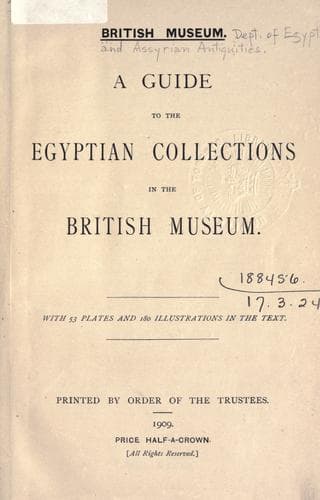
A guide to the Egyptian collections in the British MuseumBritish Museum. Department of Egyptian and Assyrian Antiquities
History
A guide to the Egyptian collections in the British Museum
British Museum. Department of Egyptian and Assyrian Antiquities
Egypt -- Antiquities
[11] A form of the old Egyptian name UN-NEFER 𓃹𓈖𓄤𓆑𓂋𓀀.
[12] Photographs of this Papyrus have been published by the Trustees of
the British Museum, £2 2_s._ per set.
[13] A full coloured facsimile has been published by the Trustees of the
British Museum, in 37 plates, portfolio, £1 11_s._ 6_d._, half bound £1
16_s._ The Egyptian Text is also issued with an English translation,
etc., 4to., £1 10_s._
[14] Also published by the Trustees of the British Museum; “Facsimiles of
the Papyri of Hunefer, Ȧnhai, Kerasher and Netchemet, with supplementary
text from the Papyrus of Nu,” fol., £2 10_s._
[15] _See_ Note 3 on page 59.
[16] 𓅓𓂝𓇌𓀁𓂋𓏲𓂧𓌗𓂋𓈖𓀁𓀀.
[17] The word =stele=, from the Greek στήλη, means literally an upright
stone, or pillar, or column, which was set up over a grave, like our
tombstone, or in a public place as a memorial of some public event.
[18] The Muḥammadan speaks of his wife as his “house,” and the
determinative to the Egyptian word shows that the ancient Egyptian held
the same idea about his wife as the modern Arab.
[19] See the flint hippopotami, crocodile, cow’s head, fish, etc., in
Table-case M (Third Egyptian Room).
[20] The word “fetish” is derived from the Portuguese _feitiço_, “a
charm.”
[21] From the Precepts of Ptaḥ-ḥetep and the Maxims of Khensu-ḥetep.
[22] The text of this extract reads:
𓅖𓍿𓈖𓏥𓊃𓊪𓊗𓇋𓊪𓈖𓉔𓄿𓂻𓆑𓂋𓊪𓏏𓇯𓉔𓄿𓂻𓆑
𓂋𓇾𓏤𓈇𓉔𓄿𓂻𓆑𓂋𓈗𓊃𓐍𓈖𓂻𓆑
𓍋𓃀𓏏𓎙𓀀𓁐𓏥𓆑𓊃𓐍𓈖𓂻𓆑𓇋𓏏𓆑𓆑𓀭𓊃𓐍𓈖𓂻𓆑𓂞𓏏𓆑𓁐𓆑
𓊃𓐍𓈖𓂻𓆑𓄠𓅱𓀀𓁐𓏥𓆑𓌣𓈖𓏌𓀀𓁐𓏥𓆑𓊃𓐍𓈖𓂻𓆑
𓌻𓂋𓏏𓀀𓁐𓏥𓆑𓊃𓐍𓈖𓂻𓆑𓐍𓈖𓄙𓅓𓋴𓀀𓏥𓆑𓊃𓐍𓈖𓂻𓆑
𓄥𓅱𓀀𓏥𓆑𓊃𓐍𓈖𓂻𓆑𓌻𓂋𓏏𓀀𓁐𓏥𓆑𓁹𓅱𓐍𓏏𓏛𓏥𓈖
𓊃𓊪𓊗𓇋𓊪𓈖𓁶𓏤𓇾𓏤𓈇𓊃𓐍𓈖𓂻𓆑𓂺𓏏𓎛𓈖𓏏𓁐𓆑𓌻𓂋𓏏𓆑
𓂋𓐍𓏏𓏛𓈖𓆑
Grant ye this Sepȧ, he may traverse heaven, he may traverse earth, he may
traverse the waters, he may meet his ancestors, he may meet his father,
he may meet his mother, he may meet his children and his brothers and
sisters, he may meet his friends, he may meet his uncles and aunts, he
may meet his connexions, he may meet his friends who did things for this
Sepȧ upon earth, he may meet his woman [whom] he loved and knew, etc.
[23] In Egyptian, =Shabti= 𓆷𓄿𓃀𓏏𓏭𓀾, or =Ushebti= 𓅱𓈚𓃀𓏏𓏭𓀾, or =Shauabti=
𓆷𓄿𓍯𓄿𓃀𓏏𓏭𓀾, 𓆷𓍯𓃀𓏏𓏭𓀾; in the plural, =Shabtiu=, or =Ushabtiu=.
[24] _E.g._, No. 1031 (389), Bay 27.
[25] Strictly speaking the _serdâb_ is a lofty, vaulted, _subterranean_
chamber, with a large opening in the north side to admit air in the hot
weather.
[26] The word “pyramid” seems to be derived from the Egyptian PEREMUS
𓉐𓂋𓂻𓅓𓅱𓋴𓉐, which probably means “a building with a sloping side.”
Public-domain text, read in full here on John Shaqi.
Reviews
Reviews
No reviews yet
Be the first to share your thoughts on this work.
Elsewhere in the archive
Join the Discussion
Join the discussion
Sign in to leave a comment or review.
Sign InorCreate an account