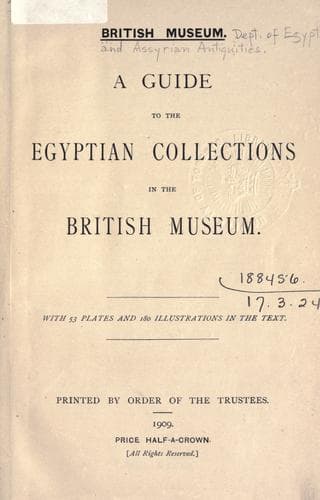
A guide to the Egyptian collections in the British MuseumBritish Museum. Department of Egyptian and Assyrian Antiquities
History
A guide to the Egyptian collections in the British Museum
British Museum. Department of Egyptian and Assyrian Antiquities
Egypt -- Antiquities
To about the same period belongs the ivory figure of a king here
reproduced (No. 7). He wears the Crown of the South, and a garment
worked with an elaborate diamond pattern. The nose is flatter and more
fleshy than in the drawings from the slate shield, and the lips are
fuller and firmer. In figures 8-10 we have representations of the women
of the Archaïc Period, about B.C. 4200. No. 8 is a female dwarf, or
perhaps a woman who belonged to one of the pygmy tribes that lived near
the Equator. No. 9 is a most interesting figure, for it illustrates the
hair-dressing and dress of the period. The features of the child, who is
carried partly on the back and partly on the left shoulder, as at the
present day, are well preserved. No. 10 represents a woman of slim build,
with blue eyes, and wearing an elaborate head-dress, which falls over her
shoulders.
PORTRAIT FIGURES OF OFFICIALS OF THE IIIRD OR IVTH DYNASTY. ABOUT B.C.
3700.
[Illustration: Figure of Betchmes, a royal kinsman.
[Vestibule, South Wall, No. 3.]]
[Illustration: Painted limestone figure of Nefer-hi.
[No. 150, Wall-case 99, Third Egyptian Room.]]
=National Character.=—Herodotus, who was an acute observer of the manners
and customs of the Egyptians, states (ii, 64) that the Egyptians were
“beyond measure scrupulous in all matters appertaining to =religion=,”
and the monuments prove him to be absolutely correct. The Egyptian
worshipped his God, whose chief symbol to him was the sun, daily and
regularly, and prayed to him morning and evening. His attitude towards
his Maker was one of absolute =resignation=. The power of God, as
displayed by the Sun, and the River Nile, and other forces of nature
filled him with awe, and made him to realize his helplessness. His
views as to the dependence of men on the sun are well illustrated by
the following extract from a hymn to Ȧten, the god of the Solar Disk:
“When thou settest in the western horizon of heaven, the earth becometh
dark with the darkness of the dead. Men sleep in their houses, their
heads are covered up, their nostrils are closed, and no man can see his
neighbour; everything which they possess could be stolen from under their
heads without their knowing it. All the lions come forth from their dens,
every creeping thing biteth, the smithy is in blackness, and all the
earth is silent because he who made them (_i.e._, all creatures) resteth
in his horizon. When the dawn cometh, and thou risest and shinest from
the Disk, darkness flieth away, thou givest forth thy rays, and the Two
Lands (_i.e._, Egypt) are in festival. Men rise up, they stand upon their
feet—it is thou who hast raised them—they wash their bodies, and dress
themselves in their clothes, and they [stretch out] their hands to thee
in thanksgiving for thy rising.” To the god of the city, or local deity,
he also paid due reverence. He worshipped Osiris, the type and symbol
of the resurrection, most truly, for on his help and succour depended
his =hope of eternal life=.
Public-domain text, read in full here on John Shaqi.
Reviews
Reviews
No reviews yet
Be the first to share your thoughts on this work.
Join the Discussion
Join the discussion
Sign in to leave a comment or review.
Sign InorCreate an account