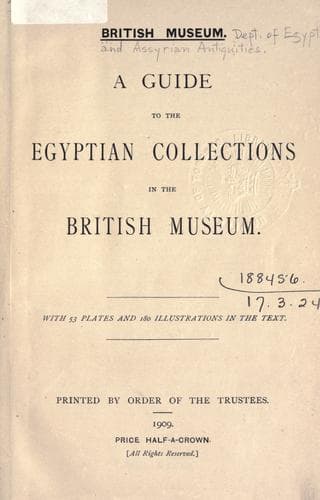
A guide to the Egyptian collections in the British MuseumBritish Museum. Department of Egyptian and Assyrian Antiquities
History
A guide to the Egyptian collections in the British Museum
British Museum. Department of Egyptian and Assyrian Antiquities
Egypt -- Antiquities
=Stories of Magicians= were as popular as books of travel, and of these
may be mentioned the group contained in the Westcar Papyrus in Berlin.
In one of them we are told of a famous magician who made a figure of a
crocodile in wax which, when thrown into the river, became a huge, living
crocodile, and devoured the man who had done the magician an injury.
In another the magician cut off a goose’s head, and placed it in one
part of the room, and the body of the bird in another; he then recited
certain words of power, and the head and body approached each other
little by little, and at length the head sprang up on the neck, and the
goose cackled. In another story we are told how one of the maidens who
was rowing the royal barge on a lake dropped one of her ornaments into
the water. A magician having been brought, stood up and recited words of
power, whereupon the half of the lake on which was the boat transferred
itself above the other half, and remained there whilst the maiden stepped
out of the boat and picked up her ornament which was seen lying on a
shard. This done, the magician repeated words of power, and the water,
which had been standing up like a wall, flowed back into its place.
Under the head of =Science= must be included the inscriptions which
deal with =Astronomy=, and contain lists of the Planets, the thirty-six
Dekans, the Signs of the Zodiac (see the coffin of Ḥeru-netch-tef-f,
First Egyptian Room, No. 6678), etc.; =Calendars= (Papyrus No. 10,474);
=Geometry= illustrated by the famous Rhind Papyrus in the British Museum
(No. 10,057); =Geography= and =Cartography=, illustrated by the papyrus
at Cairo in which the religious divisions of the Fayyûm are described,
and by the famous map of the district of the gold mines preserved in the
Museum of Turin; =Chronology=, as represented by the =Turin Papyrus=,
which, when complete, contained the names of about 300 kings of Egypt,
and the lengths of their reigns in years and months, or days. In
connection with this branch may be mentioned the =King List= of Thunurei,
found at Ṣaḳḳârah, and the King Lists of Seti I and Rameses II found at
Abydos (=Tablets of Abydos, 1 and 2=); the remains of the List made
for Rameses II are preserved in the British Museum (Southern Egyptian
Gallery, Bay 6, No. 592).
[Illustration: Marble Sundial.
Ptolemaïc Period.
[Southern Egyptian Gallery, Bay 29, No. 976.]]
Public-domain text, read in full here on John Shaqi.
Reviews
Reviews
No reviews yet
Be the first to share your thoughts on this work.
Elsewhere in the archive
Join the Discussion
Join the discussion
Sign in to leave a comment or review.
Sign InorCreate an account