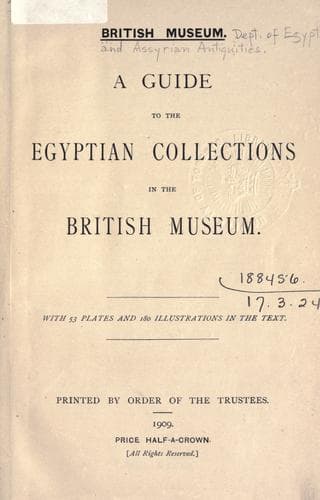
A guide to the Egyptian collections in the British MuseumBritish Museum. Department of Egyptian and Assyrian Antiquities
History
A guide to the Egyptian collections in the British Museum
British Museum. Department of Egyptian and Assyrian Antiquities
Egypt -- Antiquities
A number of valuable books dealing with =Medicine= have come down to us,
and of these one of the most interesting is the papyrus in the British
Museum, No. 10,059. It contains copies of a number of prescriptions which
date from the reign of Khufu, the builder of the Great Pyramid, about
B.C. 3730, and several of the time of Ȧmen-ḥetep III (B.C. 1450). The
largest work on medicine is contained in the Ebers Papyrus at Leipzig,
and there are medical papyri in the Museums of Paris, Leyden, Berlin,
and California (Hearst Medical Papyrus). In all these we find that magic
was considered to be as efficacious as drugs; many of the prescriptions
are to all intents and purposes magical formulas, and several suggest
charlatanism. Oil, honey, and tinctures or decoctions of simple herbs
were largely used, and the long list of names of plants, herbs, seeds,
etc., in the Ebers Papyrus proves that, though the Egyptians had little
idea of scientific =Botany=, they had a very wide knowledge of the
properties of plants, etc. =Anatomy= was studied in a practical manner,
especially for the purposes of embalming and bone-setting, but as no
treatises on the subject have come down to us, it is impossible to say
whether the Egyptians deserved the great reputations which they enjoyed
as physicians. It is tolerably certain that they made no experiments
in dissection, for the body was sacred to Osiris, and might not be
dismembered, at all events in the later times. The commonest diseases
among the Egyptians seem to have been ophthalmia, fever, maladies of the
stomach, ulcers, “Nile boils,” epilepsy and anaemia.
=Biographical inscriptions= form a very important section of the
Literature, and they throw much light, not only on the social condition
of the people, but also on the history of the country. Thus, the
inscription of the =official Ptaḥ-shepses=, who was born under the IVth
dynasty, besides enumerating the various high offices which he held,
proves that he lived through the reigns of eight or nine kings, and
thus fixes the order of the succession of several of them (see Egyptian
Vestibule, No. 32). The =official Ȧntef= lived under three kings, whose
names he gives, and thus fixes the order of their succession (Bay 4, No.
99). (=Plate XXII.=) The stele[17] of =Erṭā-Ȧntef-Ṭāṭāu= says that the
deceased was “Governor of the South” in the reign of Usertsen I, and thus
we know that an Egyptian viceroy governed the Sûdân as early as B.C.
2433 (Bay 4, No. 196). The =stele of Sa-Menthu= describes how he went to
the Sûdân to bring back gold for the king of Egypt, and tells us that he
made men, women, and children to work in digging out the quartz, and in
crushing the ore and washing the gold from it (Bay 6, No. 145). From the
biographies of the great Egyptian officials much of the history of Egypt
can be pieced together.
Public-domain text, read in full here on John Shaqi.
Reviews
Reviews
No reviews yet
Be the first to share your thoughts on this work.
Elsewhere in the archive
Join the Discussion
Join the discussion
Sign in to leave a comment or review.
Sign InorCreate an account