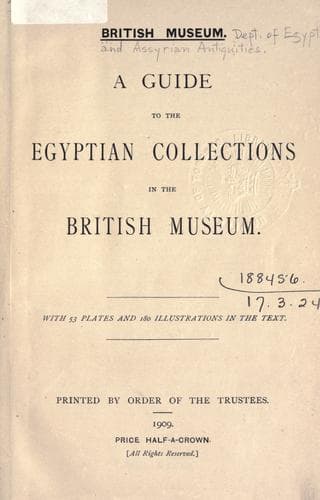
A guide to the Egyptian collections in the British MuseumBritish Museum. Department of Egyptian and Assyrian Antiquities
History
A guide to the Egyptian collections in the British Museum
British Museum. Department of Egyptian and Assyrian Antiquities
Egypt -- Antiquities
The Egyptians did not write =history= in the modern sense of the word.
Some of the kings, _e.g._, Thothmes III, inscribed =annals= on the walls
of their temples, and many others set up inscriptions to commemorate
great events. Thus Usertsen III set up at Semnah in the sixteenth year
of his reign a stele to mark the frontier of Egypt on the south, and
to proclaim his conquest of the Northern Sûdân. Ȧmen-ḥetep III, B.C.
1450, set up a stele at Semnah to record his conquest of the country of
Abhat, and the slaughter of a number of Blacks (Bay 6, No. 411). Rameses
II caused copies of his account of his fight against the Kheta, or
Hittites, to be cut on stelae, and set up in various places throughout
the kingdom, _e.g._, at Amârah and Abû-Simbel. Some of the Nubian kings
also caused good detailed accounts of their wars to be cut upon stelae,
which were set up in their capital, and in many cases these are the sole
authorities for the history of the period. Thus Piānkhi (B.C. 740) gives
a really fine account of his invasion and conquest of Egypt, even taking
the trouble to describe the military operations connected with the siege
of great cities like Memphis, his love for horses, and his devotions at
Thebes and Heliopolis. Ḥeru-sa-ȧtef, another Nubian king, gives on his
stele a careful summary of his expeditions to various parts of the Sûdân,
and lists of the tribute which he received. Casts of both monuments are
exhibited in the Southern Egyptian Gallery, Bay 18, No. 815, and Central
Saloon, No. 793. The Stele of Nȧstasen (B.C. 525) at Berlin is another
good example of this class of monument, and the text, which seems to
mention Cambyses, is of great interest. Finally may be mentioned the
stele of the Decree of Ptolemy I (B.C. 325), granting certain properties
to the temple of Buto (see the Cast in Bay 28, No. 950). The finest
general account of the reign of a king is that given by Rameses III (B.C.
1200) in the Harris Papyrus No. 1, in the British Museum (No. 9999); but
even in this more care is devoted to the glorification of the king than
to the facts of history. The inscription of Menephthah (B.C. 1250), which
is cut on the back of a stele of Ȧmen-ḥetep III in the Egyptian Museum
in Cairo, though containing useful historical indications and mentioning
the name of the Israelites 𓇌𓊃𓏮𓂋𓇋𓄿𓂋𓏤𓌙𓀀𓁐𓏪 (line 27), cannot be regarded
as a serious statement of fact, and must be classed with the panegyric
written by the court scribe Penta-urt on the exploits of Rameses II.
Public-domain text, read in full here on John Shaqi.
Reviews
Reviews
No reviews yet
Be the first to share your thoughts on this work.
Elsewhere in the archive
Join the Discussion
Join the discussion
Sign in to leave a comment or review.
Sign InorCreate an account