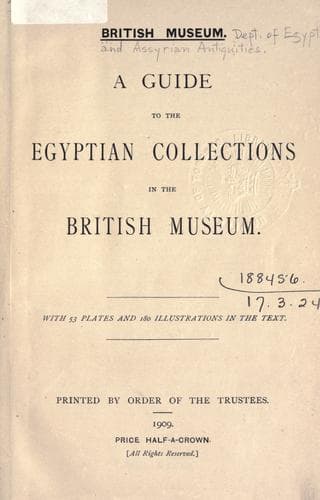
A guide to the Egyptian collections in the British MuseumBritish Museum. Department of Egyptian and Assyrian Antiquities
History
A guide to the Egyptian collections in the British Museum
British Museum. Department of Egyptian and Assyrian Antiquities
Egypt -- Antiquities
The =Historical Romances= of the Egyptians are represented by the
narrative of the =Capture of the town of Joppa= (Harris Papyrus, No.
500), and by the Dispute between Seqenen-Rā, King of Thebes, and Āpepi,
King of Avaris (Sallier Papyrus, I, No. 10,185). =Books of Magic= are
numerous, and of these may be mentioned Papyrus Salt, No. 825, and
Harris Papyrus, No. 10,051. Several =Mythological Legends= are extant,
viz., of the =Resurrection of Osiris= and the birth of Horus (on a
stele in Paris); of the =Creation of the World=, Gods, and Men (British
Museum Papyrus, No. 10,188); of the =Wars of Ḥeru-Beḥuṭet=, or Horus,
the War-god of Edfû (on the temple of Edfû); of the =Destruction of
Mankind= (in the tomb of Seti I); of how =Unȧs killed and ate the
Gods= (in the Pyramid of Unȧs); of the =Poisoning of Rā= the Sun-god
(papyrus at Turin); of the =Death of Horus= by a scorpion’s sting,
and his resurrection through Thoth (text on the Metternich Stele);
and of the =Wanderings of Isis=, with her son Horus and the Seven
Scorpion-goddesses, in the Delta (text on the Metternich Stele). The
=History of Osiris=, and of his murder by Set, has not yet been found in
Egyptian texts in a complete form, but there are frequent allusions to
this history in the inscriptions of all periods, and it is clear that
we have a tolerably accurate version of it in the narrative written by
Plutarch (_De Iside et Osiride_).
Among the =Legal Documents= in the British Museum may be mentioned
the papyri containing accounts of the prosecution of the robbers who
broke into and plundered the royal tombs under the XXth dynasty (Papyri
Abbott, Nos. 10,221 and 10,052), and the process against a man who
was charged with stealing a quantity of silver (Nos. 10,053, 10,054).
=Songs= and =Poetry= are represented by the =Love Songs= contained in
the Harris Papyrus, No. 500; the =Song of Ȧntuf=, which was sung to
the accompaniment of the harp (Harris Papyrus, No. 500); and the =Song
of the Harper=, written on the wall of a tomb at Thebes, in which the
hearers are enjoined to be happy, to anoint and scent themselves, and to
rejoice with music and song, until the day cometh when they must depart
to the land “which loveth silence.” The mutability of things, and the
fleetingness of the world are also dwelt upon. The works enumerated in
the above paragraphs are written in hieroglyphics and hieratic. The
=literature= written =in demotic= is considerable, and it consists of
books of magic, tales and stories, collections of moral aphorisms, legal
documents, marriage contracts, etc.
CHAPTER IV.
MANNERS AND CUSTOMS. MARRIAGE. POLYGAMY. HONOUR PAID TO THE MOTHER. THE
CHILD AND ITS NAME. TOYS. EDUCATION. DRESS. FOOD. AMUSEMENTS. DWELLING
HOUSES AND FURNITURE. AGRICULTURE AND CATTLE BREEDING. TRADE. HANDICRAFTS.
Public-domain text, read in full here on John Shaqi.
Reviews
Reviews
No reviews yet
Be the first to share your thoughts on this work.
Elsewhere in the archive
Join the Discussion
Join the discussion
Sign in to leave a comment or review.
Sign InorCreate an account