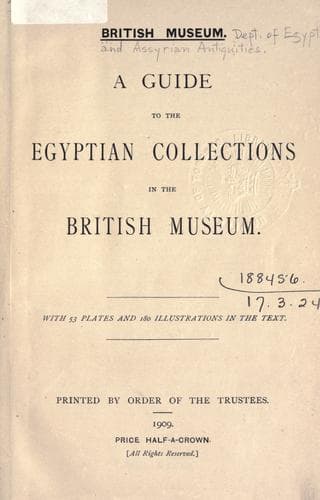
A guide to the Egyptian collections in the British MuseumBritish Museum. Department of Egyptian and Assyrian Antiquities
History
A guide to the Egyptian collections in the British Museum
British Museum. Department of Egyptian and Assyrian Antiquities
Egypt -- Antiquities
=Manners and Customs.=—The views of the Egyptians about =marriage=
closely resemble those held by many African tribes, for they married
their sisters and nieces, and sometimes indulged in =polygamy=. It is
probable that the views as to marriage which obtained generally in Egypt
were less rigid than those of Western nations. According to an ancient
legend Osiris married his sister Isis, who became by him the mother of
Horus, and he was also the father of Anubis by his other sister Nephthys.
Generally speaking, the Egyptian was the husband of one wife, who was
the mistress of his house and the mother of his children, whether she
was his sister, or his niece, or a stranger. Kings and noblemen married
several wives, and became fathers of children by many of the women of
their households. The Ptolemies, curiously enough, seeing that they were
Greeks, married their sisters and nieces, like the Egyptians. Marriage
in Egypt was, no doubt, arranged in the way common to the East, _i.e._,
it was practically a business transaction, great care being taken to
provide for the maintenance of the woman in the event of misbehaviour
either on her part or that of her husband. Whether any religious ceremony
was performed at the marriage is unknown. Girls were married before
they were fourteen years of age. The legitimate wife of a man is called
“Nebt pa,” 𓎟𓏏𓉐𓏤, _i.e._, “lady of the house,”[18] and she might of
course, be “his beloved sister”; frequently, however, the latter title
is a euphemism for “mistress,” or “concubine.” To divorce or eject the
“lady of the house” was a very difficult matter, and it was probably the
fear of possible pecuniary complications which caused the Egyptian in so
many cases to marry his sister or the woman whom he called by that name.
Moreover, it was thus easier to keep the property in the husband’s family.
Public-domain text, read in full here on John Shaqi.
Reviews
Reviews
No reviews yet
Be the first to share your thoughts on this work.
Elsewhere in the archive
Join the Discussion
Join the discussion
Sign in to leave a comment or review.
Sign InorCreate an account