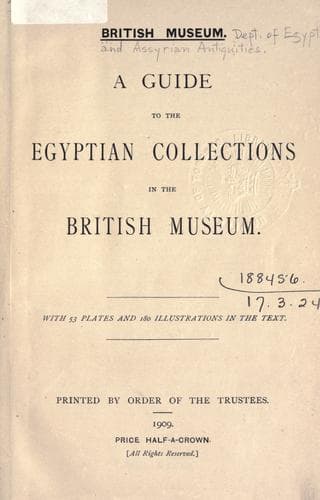
A guide to the Egyptian collections in the British MuseumBritish Museum. Department of Egyptian and Assyrian Antiquities
History
A guide to the Egyptian collections in the British Museum
British Museum. Department of Egyptian and Assyrian Antiquities
Egypt -- Antiquities
The legal =wife= was one of the freest women in the world. She went about
the house, and outside it, at will, and, unlike the modern Egyptian
women, she wore no =veil=. If she pleased, she held converse with men in
the village or market, and she suffered from none of the restrictions
which are placed upon women in the East in modern times. When the wife
became a =mother= her power and influence were greatly increased, and
the literature of ancient Egypt contains many passages which illustrate
the honour and esteem in which the “mistress of the house” was held by
her children, and on scores of stelae in the Egyptian Galleries the
name of the mother of the deceased is given, whilst that of his father
is not mentioned. The Egyptians, like many African tribes, traced their
descent through their mothers, and the views which they held concerning
the affection due to the wife from her husband, and the love which a son
should give to his mother, are well illustrated by two passages. In the
=Precepts of Ptaḥ-ḥetep= (B.C. 3200): “If thou wouldst be a wise man,
rule thy house and love thy wife wholly and constantly. Feed her and
clothe her, love her tenderly, and fulfil her desires as long as thou
livest, for she is an estate which conferreth great reward upon her lord.
Be not hard to her, for she will be more easily moved by persuasion than
by force. Observe what she wisheth, and that on which her mind runneth;
thereby shalt thou make her to stay in thy house. If thou resistest
her will it is ruin.” In the =Precepts of Khensu-ḥetep= (B.C. 1500) we
read: “When thou art grown up, and art married, and hast a house, never
forget the pains which thou didst cost thy mother, nor the care which she
bestowed upon thee. Never give her cause to complain of thee, lest she
lift up her hands to God in heaven, and He hearken to her cry [and punish
thee].”
The life of the woman in the lower classes was a hard one. She cooked the
food for her husband and children, she wove the flax into linen, attended
to all matters in the house, and usually managed to have a large family.
She was a mother at the age of fifteen, or earlier, and a grandmother
at thirty, by which time her body was bent, her forehead wrinkled, and
her face withered. Among the upper classes the process of physical
deterioration was, of course, slower, but the results were the same.
Public-domain text, read in full here on John Shaqi.
Reviews
Reviews
No reviews yet
Be the first to share your thoughts on this work.
Elsewhere in the archive
Join the Discussion
Join the discussion
Sign in to leave a comment or review.
Sign InorCreate an account