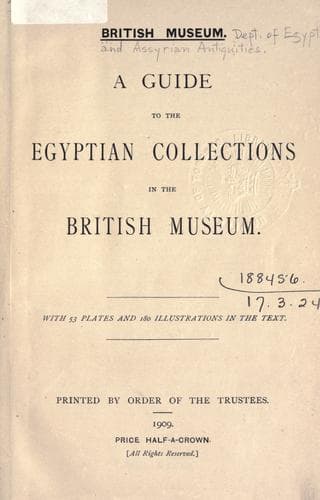
A guide to the Egyptian collections in the British MuseumBritish Museum. Department of Egyptian and Assyrian Antiquities
History
A guide to the Egyptian collections in the British Museum
British Museum. Department of Egyptian and Assyrian Antiquities
Egypt -- Antiquities
Soon after a child was born a =name= was given to it, which usually
had reference to some physical characteristic; thus a boy might be
called “Nekht” 𓈖𓆱𓐍𓏏𓂡 “Strong,” and a girl “Nefert” 𓄤𓏏 “Beautiful,”
or “Netchemet” 𓇛𓏏 “Sweet.” Pious folk introduced the name of some god
or goddess into the child’s name, _e.g._, “Rā-ḥetep” 𓂋𓂝𓇳𓏤𓊵𓏏𓊪𓀀 “Rā
is satisfied,” and loyal folk the name of the reigning king, _e.g._,
“Pepi-nekht” 𓊪𓊪𓇌𓈖𓆱𓐍𓏏𓂡 “Pepi the strong one.” Several members
of a family often bore the same name, but in these cases each was
distinguished by some “little name” (_i.e._, pet-name). As a pet-name
may be mentioned “Mȧi-sherȧui,” _i.e._, “Little Cat,” or “Pussy,”
𓏇𓇌𓈚𓂋𓇋𓏲𓏭𓅪𓁐. In well-to-do families a special day was set apart for
naming a child and this =name-day= was usually celebrated with rejoicings.
For the first three years of its life a child was wholly in its mother’s
care, and she carried it about on her back or left shoulder (see the
ivory figure No. 41 in Table-case L in the Third Egyptian Room). For the
next three or four years of its life it went about naked, whether boy
or girl, gentle or simple; indeed a grandson of Khufu, the builder of
the Great Pyramid, went to school unclothed. The heads of children were
clean-shaven, with the exception of a lock of hair on the right side
of the head. Little girls sometimes wore an amulet on their breast or
body in order to avert the “evil eye,” and perhaps a cheap bracelet or
necklace. They played with =dolls=, numerous examples of which have come
down to us (see Standard-case C in the Fourth Egyptian Room). Like all
children, Egyptian children loved =toys= of all kinds. As examples of
these may be mentioned the =cat= with a movable lower jaw, the =elephant=
and his rider, each having movable limbs, the =negro= being pursued by an
animal, the =ape= drawing a chariot, the =cat-headed dwarf=, the =lion=
killing its prey, the toy dog, hippopotamus, etc. The =balls= they played
with were made of porcelain, papyrus, leather stuffed with chopped straw,
etc. (See Standard-case C.)
Public-domain text, read in full here on John Shaqi.
Reviews
Reviews
No reviews yet
Be the first to share your thoughts on this work.
Elsewhere in the archive
Join the Discussion
Join the discussion
Sign in to leave a comment or review.
Sign InorCreate an account