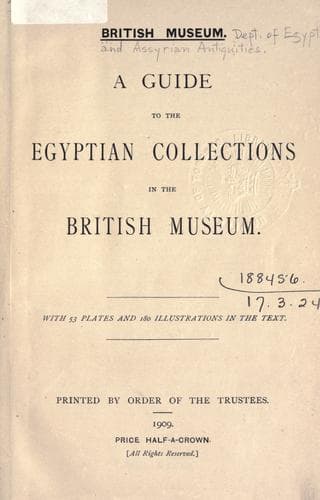
A guide to the Egyptian collections in the British MuseumBritish Museum. Department of Egyptian and Assyrian Antiquities
History
A guide to the Egyptian collections in the British Museum
British Museum. Department of Egyptian and Assyrian Antiquities
Egypt -- Antiquities
=pomades= were very largely used in all periods. Strong scented woods
and herbs were pounded and mixed with oil, and rubbed into the body,
and =scents= were in ancient days, as now, in great demand. Often women
carried a =fan= and a =mirror=. A fine collection of mirrors is exhibited
in Wall-cases Nos. 182-187 in the Fourth Egyptian Room.
=Food.=—The food of the lower classes consisted chiefly of =bread= and
=vegetables=. The bread was made of a kind of millet, like the modern
=dhurra=, =barley=, and rarely of =wheat=. The grains were rolled and
crushed on a stone and then both the flour and the =bran= were mixed
with water into a stiff paste; from this pieces were broken off and
flattened out by the hand into cakes of various degrees of thickness,
which were baked on hot stones, or in mud-lined ovens. (See the examples
in Table-case H in the Third Egyptian Room.) Bread-cakes were made in
a variety of shapes, _e.g._, 𓏏, 𓏙, 𓏐, , 𓊔, , [glyph not in Unicode],
𓏖, 𓏑, etc. Among vegetables may be mentioned =onions=, =cucumbers=
of various kinds, =beans=, =peas=, =lentils=, =radishes=, =pumpkins=,
=water-melons=, =leeks=, =garlic=, =roots= of the turnip and carrot
class, and vegetables belonging to the class of the modern _bâmia_,
_bâdingân_ (egg-plant), _melûkhîyah_ (=spinach=), etc. All these grew in
great abundance, and, in growing, needed little attention, and formed
very important items in the food of all classes. (Compare Numbers xi,
4, 5: “And the children of Israel also wept again, and said, Who shall
give us flesh to eat? We remember the fish, which we did eat in Egypt
freely; the cucumbers, and the melons, and the leeks, and the onions, and
the garlick.”) =Milk= was drunk in large quantities by the living and
was offered to the dead, and =cheese= was everywhere a common article
of food. Among fruits may be mentioned =figs=, =dates=, =mulberries=,
=grapes=, and probably =pomegranates=. From both figs and dates =syrups=
and =sweetmeats= must have been made. =Fish= was largely eaten by the
poorer classes, but from various passages in the texts we learn that
the “eaters of fish” were unclean ceremonially. The =animal food=
eaten consisted of the flesh of the sheep, goat, ox, gazelle, ariel,
the antelope and other animals of that class, etc.; domestic animals
intended for human food were often =fattened artificially=. Groups of
swine are represented on the monuments occasionally, but the =pig= must
have been regarded as an unclean animal. Among the birds eaten were the
=goose=, =duck=, =pigeon=, =dove=, and the several kinds of birds which
were found in the marshes all over Egypt in ancient days. =Geese= also
were =fattened artificially=, and the trade in them must have been very
large. (See the wall painting in Standard-case I in the Third Egyptian
Room, where the inspection and counting of geese are represented.)
=Salt= was obtained from the lakes on the sea-coast, and =rock-salt=
from several places in the Western Desert.
Public-domain text, read in full here on John Shaqi.
Reviews
Reviews
No reviews yet
Be the first to share your thoughts on this work.
Elsewhere in the archive
Join the Discussion
Join the discussion
Sign in to leave a comment or review.
Sign InorCreate an account