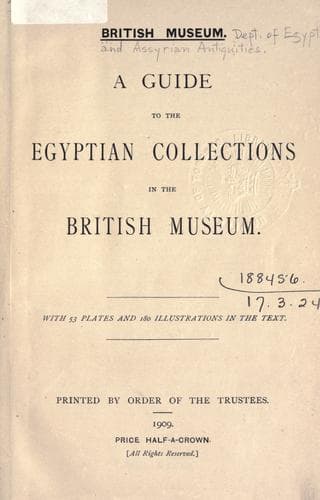
A guide to the Egyptian collections in the British MuseumBritish Museum. Department of Egyptian and Assyrian Antiquities
History
A guide to the Egyptian collections in the British Museum
British Museum. Department of Egyptian and Assyrian Antiquities
Egypt -- Antiquities
=Dress and ornaments.=—The garments worn by the Egyptians were made
of =linen=, for wool was regarded as unclean. The earliest masculine
garment was the =loin-cloth=, the primitive form of which was preserved
for ceremonial purposes until a late period. Above it a =girdle=, or
belt, was usually added, and to this a =tail=, either that of some
animal, or an imitation made of leather, was fastened. The tail is worn
by many African peoples to this day. As time went on and fashion changed
the loin-cloth developed into a sort of skirt, which varied in length,
fulness, and folds, or a short kilt projecting in a peak just above the
knees. Later both men and women wore a sort of =shirt=, and over this
a loose flowing garment which reached from the neck to the feet. The
linen worn by women of the upper classes was of very fine texture, and
in the luxurious period of the XVIIIth and XIXth dynasties their apparel
was often very voluminous. The dress of men and women under the VIth
dynasty is well illustrated by the scenes from a maṣṭaba tomb (see the
Assyrian Saloon) reproduced on =Plate IX=, and under the XVIIIth dynasty
by the figures on the stele of Kaḥu (Bay 12, No. 514) (=Plate X=). Both
men and women wore =wigs=, which were sometimes very full and heavy,
but women plaited their natural hair. =Sandals= were made of papyrus
and palm-fibre, neatly woven or plaited, and sometimes of goat skin, or
gazelle skin, well tanned and stained a pink colour. (See Table-case A
in the Third Egyptian Room and Standard-case L in the Fourth Egyptian
Room.) The “=cone=” was worn on the head by men and women, sometimes with
a lotus flower or lily attached to it. According to some it contained a
ball saturated with oil or pomade of some kind, which ran slowly into
the hair, and so spread over the head and shoulders, causing pleasing
sensations to him on whose head the ball was. The =headdresses= of
the king and queen were very elaborate, whilst those of ordinary folk
consisted of a bandlet, more or less decorated. Men of position always
carried a staff or =walking stick= as a sign of authority, and those whom
the king had honoured by the gift of a =gold collar= wore it on every
important occasion. Both men and women wore rings, anklets, bracelets,
armlets, necklaces, elaborately ornamented collars, pectorals, pendants,
amulets, and earrings, just as they do in Egypt and the Sûdân at the
present time. Egyptian women stained the nails of their fingers and toes
a yellowish red with the juice of the =ḥenna= plant; they painted their
faces with a sort of =rouge=, and their eyelids and eyebrows with a
preparation of antimony (stibium, or =koḥl=), and they added under the
eyes thick lines of paint to make them appear large and full. Both men
and women sometimes decorated their bodies with =tattoo= markings, which
originally probably had a religious, or tribal, import. The burning winds
and heat made the use of unguents an absolute necessity, and =oils= and
Public-domain text, read in full here on John Shaqi.
Reviews
Reviews
No reviews yet
Be the first to share your thoughts on this work.
Elsewhere in the archive
Join the Discussion
Join the discussion
Sign in to leave a comment or review.
Sign InorCreate an account