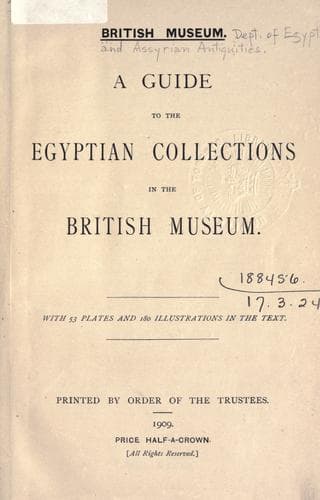
A guide to the Egyptian collections in the British MuseumBritish Museum. Department of Egyptian and Assyrian Antiquities
History
A guide to the Egyptian collections in the British Museum
British Museum. Department of Egyptian and Assyrian Antiquities
Egypt -- Antiquities
The =camel= was certainly known in the Predynastic Period, for the head
of an earthenware figure of one was found at Abydos a few years ago;
but this animal cannot have been used for transport purposes, or bred
by the early Dynastic Egyptians, for otherwise we should find pictures
of him on the walls of the tombs. One of the earliest mentions of the
camel is contained in the “Travels of an Egyptian” (Brit. Mus. Papyrus
No. 10,247), where we find the Semitic word for camel under the form
_kamāȧl_ 𓎡𓄿𓅖𓇋𓄿𓏭𓂋𓏤𓄛. The camel plays no part in Egyptian mythology. The
commonest beast of burden was the =ass=, which was bred in large numbers,
and was employed like oxen for treading out the corn and for riding. One
of the desert caravans of Ḥer-Khuf, an old feudal lord of Elephantine
under the VIth dynasty, contained 300 asses. The ass was admired for his
strength, endurance, and virility, and he appears in Egyptian mythology
as a form of the Sun-god. =Sheep= and =goats= were always bred in large
numbers. The =horse= may have been known in Egypt in the XIIth dynasty,
but he was not bred there until the experience gained by the Egyptians
in their Asiatic campaigns showed them his value in military operations.
Horses must have been plentiful in Egypt under the XXIInd dynasty, “for
Solomon had horses brought out of Egypt,” and “a chariot came up and
went out of Egypt, for six hundred _shekels_ of silver, and an horse for
an hundred and fifty” (1 Kings x, 28, 29). Excellent representations of
horses are seen in the wall-painting in Standard-case D in the Third
Egyptian Room, and in the battle-scene of Rameses II on the South Wall of
the Fourth Egyptian Room, above the cases.
The =pig= is not often represented on the monuments, but a painting in
a tomb at Thebes shows that swine were used on farms for treading out
the corn. From a very early period the god of evil, Set, was believed
to have appeared in the form of a “black pig” 𓂋𓂋𓃟𓆎𓅓𓏜 when he smote the
Eye of Horus (_i.e._, the Sun). The gods then decreed that pigs should
be sacrificed to Horus, with bulls, sheep, and goats. In one form of the
Judgment Scene the pig is the emblem of evil, and also in the Book of the
Dead (see Chapters XXXVI and CXII). On the other hand, the =sow= was an
animal sacred to Isis, and small figures of sows were worn as amulets
attached to necklaces. (See the figures of sacred animals in Wall-case
No. 121 in the Third Egyptian Room.) Under the early dynasties a species
of =ram=, which became the symbol of the god Khnemu 𓁠, with flat horns
projecting at right angles from the sides of his head 𓃝, was common
in Nubia, but it appears to have died out before the end of the XIIth
dynasty. Another kind of ram apparently indigenous to Nubia, became the
symbol of the god Ȧmen of the Sûdân.
Public-domain text, read in full here on John Shaqi.
Reviews
Reviews
No reviews yet
Be the first to share your thoughts on this work.
Elsewhere in the archive
Join the Discussion
Join the discussion
Sign in to leave a comment or review.
Sign InorCreate an account