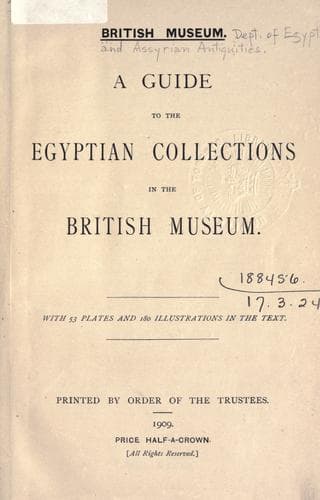
A guide to the Egyptian collections in the British MuseumBritish Museum. Department of Egyptian and Assyrian Antiquities
History
A guide to the Egyptian collections in the British Museum
British Museum. Department of Egyptian and Assyrian Antiquities
Egypt -- Antiquities
The principal instrument used in farming was the =plough= 𓍁, the share
of which was made of a piece of wood tied to a long pole; at the other
end of the pole was fixed a bar, which was made fast to the horns of the
cows which drew the plough. This primitive instrument was little more
than a stout stake tied to a pole which was drawn over the ground, and
made a very shallow furrow. The stiff Nile mud was further broken up by
the =hoe= 𓌸, of which examples may be seen in the Wall-case No. 102 in
the Third Egyptian Room (No. 281, etc.). As soon as the fields were ready
to receive the seed, the =sowing= took place, and when the seed had been
cast into the furrows it was trodden in by the animals on the farm being
driven over it. The sowing was done by hand, and no drill appears to have
been used. The fields were watered either by allowing the water to flow
from a large basin or reservoir on to them, or by machines which lifted
the water from the canal to their level, or from the Nile itself. The
commonest water-raising machine resembled the modern =shâdûf=, which was
worked by one or two men. Two stout stakes were driven firmly into the
ground at the edge of the stream, and between them was tied a long pole,
heavily weighted with a mass of mud or stone at one end. To the end of
the longer half of the pole a rope and a leather bucket were tied. The
labourer drew the pole down until the bucket entered the stream, and the
weight of the counterpoise at the other end helped him to raise the water
to the surface of the field, where he poured it into the channel leading
to the growing crop.
At the =harvest= the crops were cut with the small =sickle= 𓌳 (see
Table-case K in Third Egyptian Room, Nos. 1-4), which in primitive times
was made of flint or a series of flints set in a wooden frame [glyph
not in Unicode], and in later times of iron or bronze. The wheat or
barley was tied up into small bundles by the reapers, and carried to the
=threshing floor=, where the grain was trodden out by animals—donkeys,
swine, etc. The threshing floor, as we may see from the wall paintings
and pictures on papyri, was circular in form, and its edges were raised,
, thus preventing the animals, as they ran round and round in it, from
scattering the grain with their feet. The operations of ploughing,
reaping, and =treading out the corn= are well illustrated by the Vignette
No. 35, from the Ani Papyrus. (See Standard-case G in the Third Egyptian
Room.) When the grain had been trodden out, it was thrown up by hand
into heaps, the wind blowing away the chaff whilst it was in the air.
It was next carried in baskets, or bags, to the store or granary, which
was usually near the house. Here it was either piled up in heaps on
mud stands with raised edges 𓊚, or poured into large bins built in the
walls along a rectangular courtyard. (See the models of granaries in
Standard-case C in the Fourth Egyptian Room.)
Public-domain text, read in full here on John Shaqi.
Reviews
Reviews
No reviews yet
Be the first to share your thoughts on this work.
Elsewhere in the archive
Join the Discussion
Join the discussion
Sign in to leave a comment or review.
Sign InorCreate an account