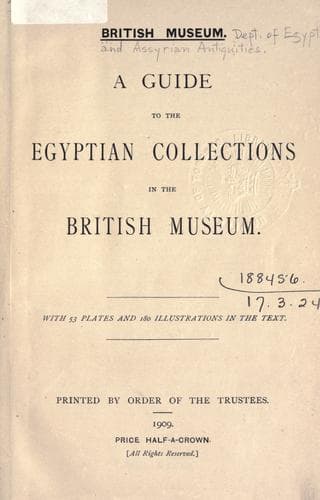
A guide to the Egyptian collections in the British MuseumBritish Museum. Department of Egyptian and Assyrian Antiquities
History
A guide to the Egyptian collections in the British Museum
British Museum. Department of Egyptian and Assyrian Antiquities
Egypt -- Antiquities
Among the =imports= may be mentioned =copper= and =tin= from Cyprus and
Northern Syria, =cedar= wood from the Lebanon Mountains, =lapis-lazuli
paste= from Babylonia, =myrrh= and =spices= for embalming, =skins=,
=cattle=, =ebony=, =ostrich feathers=, =bows=, =pillows=, =chairs=,
=couches=, =fans=, =mats=, =shields=, etc., from the Sûdân; and a number
of the products of India and Arabia must have found their way into Egypt
by means of the caravans which crossed the desert to some place near the
modern Suez or Ḳanṭarah, and some sea-borne goods entered Egypt by the
route from the Red Sea to the Nile, _viâ_ Ḳuṣêr and Ḳena. The importance
of Egypt as a trading centre, and as the natural market half-way between
the East and the West, was not fully recognized until the Ptolemaïc
Period, about B.C. 250. Business was carried on chiefly by =barter=, so
much wheat, barley, or millet being the value of a sheep, bull, cow, or
goat, linen, etc. The Egyptians used =weights= and =measures=, _e.g._,
the =royal cubit= of 7 palms or 28 fingers, the =little cubit= of 6 palms
or 24 fingers, the =palm= of 4 fingers, the =hand= of 5 fingers, the
=fist= of 6 fingers, and the =finger=; of =dry measure=, the =hen=, the
=ṭenȧt=, the =ȧpt=, etc.; of =weight=, the =ṭeben= (= 3⅕ ounces), the
=ḳeṭ= = ⅟₁₀th of a ṭeben, etc. The use of the =scales= was well known,
but there is no evidence that the steelyard was employed before the
Roman Period. =Stamped money= was unknown among the Egyptians, but they
appear to have used a =currency= which consisted of pieces of wire made
of copper, iron, or gold, and gold-dust. =Ring-money=, made of gold, is
represented in the painting on the south wall of the Fourth Egyptian
Room; and also the little bags containing gold dust. Ring-money in gold
is in use at the present day along the east coast of Africa, and in
certain parts of the Sûdân copper wire still possesses great purchasing
powers.
[Illustration: Jewellers drilling and polishing beads, etc.
XVIIIth dynasty.
[Northern Egyptian Gallery, Bay 12, No. 518.]]
Public-domain text, read in full here on John Shaqi.
Reviews
Reviews
No reviews yet
Be the first to share your thoughts on this work.
Elsewhere in the archive
Join the Discussion
Join the discussion
Sign in to leave a comment or review.
Sign InorCreate an account