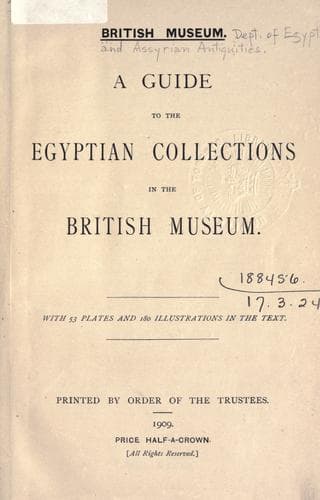
A guide to the Egyptian collections in the British MuseumBritish Museum. Department of Egyptian and Assyrian Antiquities
History
A guide to the Egyptian collections in the British Museum
British Museum. Department of Egyptian and Assyrian Antiquities
Egypt -- Antiquities
=Handicrafts.=—The Egyptian of all periods was a skilled =potter=. In
the earliest times the potter’s wheel was unknown, and every vessel was
shaped by the potter’s hand or foot. Vessels of all sorts, shapes, and
sizes were made with great skill, and in later periods were decorated
with linear and other designs. The art of the potter throve until the
advent of the conquerors from Asia, when it began to languish; and in
a few centuries earthenware vessels were superseded by stone. Good
examples of Predynastic and Archaïc pottery will be found in the cases
on the Landing of the North-West Staircase, and of the pottery of the
later periods in the Fourth Egyptian Room. The =Basket-weaver= wove rush
matting, plaited mats and sandals, and made ropes and baskets of all
kinds. Specimens of his work will be seen in Table-case A in the Third
Egyptian Room, and in Wall-cases 182-187 in the Fourth Egyptian Room.
Owing to the abundance of flax in Egypt the trade of the =linen-weaver=
was in all periods most flourishing, and the “fine linen of Egypt” was
famous throughout Western Asia and the seaports of the Mediterranean.
A staff of linen weavers appears to have been attached to each temple,
and the sale of their work produced a large revenue; a portion was paid
to the king, and the rest was kept by the priests. The city of Ȧpu
(Panopolis, the modern Akhmîm) was one of the chief seats of the linen
industry, and to this day the dyed curtains of Akhmîm are used throughout
Egypt. The craft of the =jeweller= was very important, for, in addition
to the rings, bracelets, necklaces, pendants, earrings, etc., which he
made in gold and silver, he cut the =amulets= and ornaments in amethyst,
garnet, agate, onyx, chalcedony, carnelian, jasper, mother-of-emerald,
lapis-lazuli, turquoise, rock-crystal, basalt, porphyry, haematite,
obsidian, coral, mother-of-pearl, etc. (See Table-cases F, J.) The finest
work of the jeweller belongs to the XIIth dynasty, and the workmen of
that period brought the art of =inlaying precious stones= and metals to a
very high pitch of perfection. Some think that the Egyptians understood
the art of =enamelling=, but authorities are not agreed on this point.
Public-domain text, read in full here on John Shaqi.
Reviews
Reviews
No reviews yet
Be the first to share your thoughts on this work.
Elsewhere in the archive
Join the Discussion
Join the discussion
Sign in to leave a comment or review.
Sign InorCreate an account