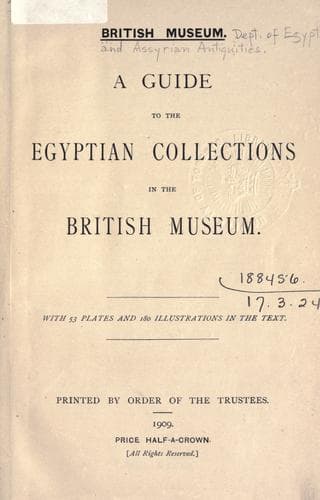
A guide to the Egyptian collections in the British MuseumBritish Museum. Department of Egyptian and Assyrian Antiquities
History
A guide to the Egyptian collections in the British Museum
British Museum. Department of Egyptian and Assyrian Antiquities
Egypt -- Antiquities
In the Northern and Southern Egyptian Galleries among the finest examples
of large statues may be mentioned the three grey granite =statues
of Usertsen III=, B.C. 2330, each of which represents the king at a
different period of his life (Nos. 158, 159, 160; see =Plate XXV=); the
dark granite =head of Ȧmen-em-ḥāt III=, of the XIIth dynasty (No. 774;
see =Plate XXVI=); the red granite statue of =Sekhem-uatch-taui-Rā=,
a king of the XIIIth dynasty (No. 276, =Plate XXVII=); the =head
of Thothmes III=, B.C. 1550 (No. 360; =Plate XXXI=); the heads of
=Ȧmen-ḥetep III=, B.C. 1450 (Nos. 416, 417); the white limestone statues
of an official and his wife, of very fine work (No. 565); and the granite
statue of Isis holding a figure of Osiris between her wings (No. 964).
The statues and portrait figures of the latter part of the XVIIIth, XIXth
and XXth dynasties lack the fidelity to nature of those of the Ancient
and Middle Empires, and it is clear that about B.C. 1200 both statues and
figures were kept in stock by funerary masons, who merely added the names
of deceased persons to them after they were sold.
Under the Saïte kings of the XXVIth dynasty a =Renaissance= took place,
and for a short time painters, sculptors, and scribes modelled their
works on examples drawn chiefly from the monuments of the Ancient Empire.
CHAPTER VI.
THE KING AND HIS CHIEF OFFICERS OF STATE AND SUBJECTS. MILITARY SERVICE.
The =King= of Egypt was absolute master of the country, which had been
given to him by the gods, and of every man, woman, and child, and of
everything in it from one end to the other. He was the son of Ḥeru-ur,
_i.e._, Horus the Great, the oldest of all the gods of Egypt, whose
attributes were, at a later period, usurped by Rā, the Sun-god, and was
declared to be of the very substance and essence of the god. He was
believed to be a god, and was worshipped as a god, and his statues and
figures were placed among the statues of the gods, and with them received
the adoration of men. His word on any subject was final, his authority
limitless, in his person he united the intelligence and strength of all
beings in heaven and on earth; men lived by his grace only, and at a word
from him they were slain. In short, the Egyptians were serfs and bondmen
of the king, the counterpart, image and symbol of the god of heaven.
He possessed =five= great =names= or titles: 1. A =Horus name=, as the
descendant of Horus. 2. A =Nebti name=, as representative of Nekhebit and
Uatchit, the great goddesses of the South and North. 3. A =Horus of gold
name=. The blood of the sun-god was supposed to be made of gold, and as
the divine blood ran in the king’s veins, a “name of gold” was given to
him. 4. A =Suten Bȧt name=, as king of the South (_Suten_) and King of
the North (_Bȧt_). 5. A =Son of Rā name=, or personal name of the king.
Thus, the five names of Usertsen III were:
Horus name, NETER KHEPERU. This was placed in a _serekh_ thus:—
Public-domain text, read in full here on John Shaqi.
Reviews
Reviews
No reviews yet
Be the first to share your thoughts on this work.
Elsewhere in the archive
Join the Discussion
Join the discussion
Sign in to leave a comment or review.
Sign InorCreate an account