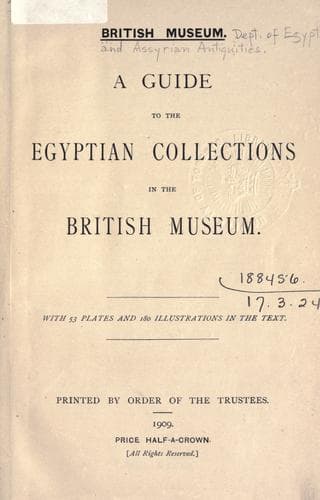
A guide to the Egyptian collections in the British MuseumBritish Museum. Department of Egyptian and Assyrian Antiquities
History
A guide to the Egyptian collections in the British Museum
British Museum. Department of Egyptian and Assyrian Antiquities
Egypt -- Antiquities
=Military service.=—The Egyptian was neither a fighting man nor a soldier
by nature, and except for a few comparatively short periods in her
history, Egypt never had an =Army= in the sense in which the word is
used by Western Nations. The Egyptian hated military service, and in any
conflict which resembled war he generally ran away. When a hostile force
threatened the country, the head of each nome collected a number of men
from his district, and armed them as well as he could, and then sent his
contingent to some place appointed by the king. Individual nobles also,
no doubt, sent companies of men more or less armed from their estates to
fight the king’s battles. The peasant, or _fellaḥ_, was then, as now, a
formidable opponent in a fight, when armed with a stout stick, or club,
especially when he could fight under cover or behind a wall; but anything
like organized resistance terrified him, and rendered him useless. On the
other hand, the native of the Sûdân was a very fine fighter, and whenever
it was possible Pharaoh stiffened his troops with regiments of Blacks.
Thus, if we may believe the account of Unȧ, the commander-in-chief of
Pepi, a king of the VIth dynasty, his army contained Blacks from every
great province of the Sûdân, and numbered “many times ten thousand.” In
the Asiatic campaigns, which produced such great spoil for Egypt, the
organizers of these wars, which are better termed “military raids,” and
the finest fighters in them were either Blacks, or of Sûdânî origin.
Egypt had only need of soldiers in the strict sense of the word when
it was necessary to suppress sudden rebellions in the provinces, or to
compel tributary kings to pay what was due from them, or to provide
escorts to Government trading expeditions. In times of peace the troops
of the militia laid down their clubs, bows, daggers, and spears, and
worked at their trades or cultivated the fields. Military exercises,
drillings, manœuvres, etc., there were none.
The Predynastic Egyptian warrior armed himself with a short, stout
stick; later it was weighted at one end with a piece of flint or stone,
and so became a kind of =club=. A flat piece of flint, or stone, with
a roughly-formed cutting edge, bound to a stick by thongs of leather,
served as an =axe=. Double-headed axes were also known, and =knives=,
=spear-heads=, arrow-heads, etc., were commonly used.
Public-domain text, read in full here on John Shaqi.
Reviews
Reviews
No reviews yet
Be the first to share your thoughts on this work.
Elsewhere in the archive
Join the Discussion
Join the discussion
Sign in to leave a comment or review.
Sign InorCreate an account