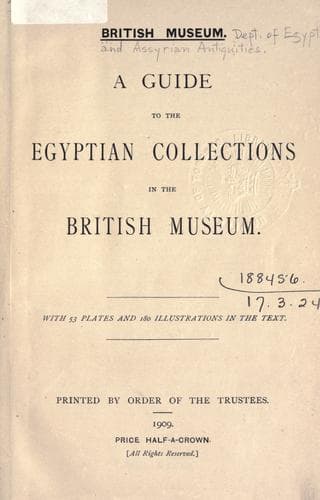
A guide to the Egyptian collections in the British MuseumBritish Museum. Department of Egyptian and Assyrian Antiquities
History
A guide to the Egyptian collections in the British Museum
British Museum. Department of Egyptian and Assyrian Antiquities
Egypt -- Antiquities
The =equipment= of the soldier of the Ancient Empire was simple. He wore
a sort of skull =cap=, of leather(?), with a feather or two stuck in
the top; he fought with a =club= 𓌉, or =mace=, and a =bow= 𓌔, carrying
his =flint-tipped arrows= in a leather quiver slung over his back, and
he caught the blows and arrows of his foe on a large =leathern shield=,
which was sometimes ornamented with the badge of his master or his
family. At a later period he wore a =leathern shirt= to protect his body,
and he added to his arms a long =spear=, a knife, or =dagger=, with a
curved blade 𓌛𓑀, and sometimes a =battle-axe=. The equipment of the
mercenaries of a still later period differed in many details from that
of the native Egyptian. (For examples of bows, arrows, daggers, spears,
etc., see Table-case B in the Third Egyptian Room.)
The =horse= and =chariot= were unused in Egypt before the kings of
the XVIIIth dynasty began to make conquests in Western Asia. At a
comparatively early period the Egyptians began to fortify their towns
with walls and strong gates, and in the XIIth dynasty King Usertsen III
erected a series of =forts= in the Second Cataract to prevent the Nubians
from descending the river and laying Egypt waste. One strong fort was
built near Buhen (Wâdî Ḥalfah), another on the island now called Jazîrat
al-Malik, one at Semnah, and another exactly opposite at Kummah. The
walls were built of mud bricks, many feet thick, and long slopes cased
with stone were built against them. Within each enclosure were series of
chambers for storehouses and barracks, and at one corner a small temple,
dedicated to the chief god of the district. Another series of forts was
built on the frontier between the north-east line of the Delta and Syria,
generally of great strength.
The geographical position of Egypt made it unnecessary for her to
possess a =navy=, and, moreover, the peasants were as little fitted to
become sailors as soldiers. The most important sea-fight in which the
Egyptians took part was the engagement in which Rameses III (B.C. 1200,
or later) vanquished the confederation of Libyan tribes. This king built
war-ships, and manned them with crews from the seafaring peoples of the
Mediterranean, and he succeeded in gaining a signal victory by sea and
land over his enemies.
CHAPTER VII.
EGYPTIAN RELIGION. EARLY BELIEF IN SPIRITS, FETISHES, COMPANIES OF GODS.
THE WORD FOR GOD AND “GOD.” LIST OF GODS. POLYTHEISM. ONENESS OF GOD.
LEGENDS OF THE GODS. OSIRIS AND THE RESURRECTION. THE JUDGMENT. THE OTHER
WORLD. DOCTRINE OF RETRIBUTION. AMULETS.
Public-domain text, read in full here on John Shaqi.
Reviews
Reviews
No reviews yet
Be the first to share your thoughts on this work.
Elsewhere in the archive
Join the Discussion
Join the discussion
Sign in to leave a comment or review.
Sign InorCreate an account