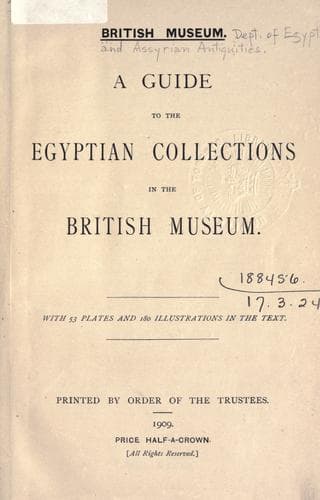
A guide to the Egyptian collections in the British MuseumBritish Museum. Department of Egyptian and Assyrian Antiquities
History
A guide to the Egyptian collections in the British Museum
British Museum. Department of Egyptian and Assyrian Antiquities
Egypt -- Antiquities
MA-ḤES 𓌳𓎛𓎿𓋴𓁻, the Lion-god; lion-goddesses were numerous,
_e.g._, Sekhet, Pekhth, Tefnut, etc.
MAFṬET 𓌳𓄿𓆑𓂧𓏏, the Lynx-goddess.
BAST 𓎯𓏏𓆇, the Cat-goddess; the word for “cat” was _Mȧu_
𓏇𓇋𓅱𓃠.
ȦNPU 𓇋𓈖𓊪𓅱, the Dog, or Jackal-god.
APUAT 𓄋𓈐, the Wolf-god.
KHATRU 𓆼𓄿𓏏𓂋𓅱, the Ichneumon-god.
The following =birds= were sacred: The phoenix, _Bennu_ 𓃀𓈖𓏌𓅱𓅣; the
vulture, _Nerȧu_ 𓈖𓂋𓇋𓅱𓅐; the hawk, _Bȧk_ 𓃀𓇋𓎡𓅄; the hawk of gold, _Bȧk en
nub_ 𓃀𓇋𓎡𓅄𓈖𓋞𓈒𓏦; the divine hawk, _Bȧk netri_, 𓃀𓇋𓎡𓅄𓊹𓏏𓂋𓏭𓏜; the ibis,
_Habû_ 𓉔𓄿𓃀𓅱𓅝; the swallow, _Ment_ 𓏠𓈖𓏏𓅨; the goose, 𓅬, of which there
were several kinds; etc.
The following =reptiles= and =insects= were sacred: the turtle, _Āpesh_
𓂝𓊪𓈚𓆉, or _Sheta_ 𓈚𓏏𓄿𓆉; the snake, _Sa-ta_ 𓅭𓇾𓏤𓈇; the scorpion, _Serk_
𓋴𓂋𓎡; the _Āpshait_ beetle, 𓂝𓊪𓆷𓄿𓇌𓆤; the “praying mantis”, _Ābit_
𓍋𓃀𓇋𓇋𓏏𓅬; the grasshopper, _Saneḥemu_, 𓅭𓈖𓈞𓅓𓅱𓆧; _Kheprerȧ_ the beetle,
_Scarabaeus sacer_, 𓆣𓂋𓂋𓇋𓅬.
The following =fish= were sacred: The _Ȧbṭu_ 𓋁𓃀𓂧𓅱𓆟; the _Ȧnt_ 𓇋𓆛𓈖𓏏𓆟,
which announced the rise of the Nile; the _Āḥa_ 𓂚𓄿𓆟; the _Āṭ_ 𓂝𓂧𓆟;
the _Utu_ 𓎘𓅱𓆟; the _Meḥit_ 𓎖𓎛𓇌𓏏𓆟; the _Nār_ 𓈖𓂝𓂋𓆟; etc. Classical
writers mention the Oxyrhynchus, the Phagrus, the Latus, the Lepidotus,
the Silurus, the Maeotes, etc., but authorities differ in their
identifications.
=Number of the gods.=—As every district, city, town, and village
possessed a god, with a female counterpart and a son, and also a being
of evil, or devil, to say nothing of the creatures who, in modern times,
would be called vaguely “spirits,” or “fairies,” it follows that the
“gods” of the Egyptians must have been very numerous. The names of a
great many have been lost, but about 200 gods are mentioned in the
Pyramid Texts, about 480 in the Theban Recension of the Book of the Dead,
and about 1,200 in the various works which deal with the Other World; a
total of about 2,200 names has been noted. The Egyptians tried to reduce
the large number of their gods by declaring that their gods were merely
_forms_ of the great Sun-god Rā, who was said to have “created the names
of his members, which became the gods who are in the following of Rā”
(Book of the Dead, xvii, 11). The Egyptian system of =Polytheism= (not
Pantheism) appears to have been well suited to the early conditions of
the country, but several facts make it certain that attempts were made by
the priests to give their religion a distinctly monotheistic character.
The results of their endeavours in this respect find expression in many
texts. Under the Ancient Empire we read in the Pyramid Texts of a God who
was the lord of heaven, who gave life to the dead, and who was entirely
different in every way from the “gods.” In Moral Precepts we have such
phrases as: “The things which God doeth cannot be known.” “The eating of
Public-domain text, read in full here on John Shaqi.
Reviews
Reviews
No reviews yet
Be the first to share your thoughts on this work.
Elsewhere in the archive
Join the Discussion
Join the discussion
Sign in to leave a comment or review.
Sign InorCreate an account