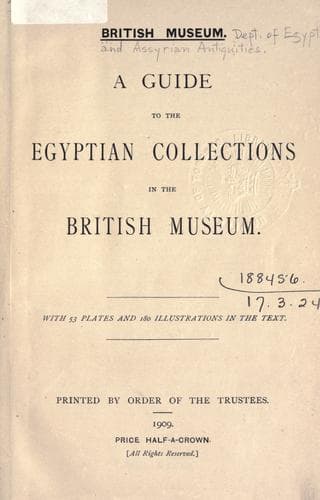
A guide to the Egyptian collections in the British MuseumBritish Museum. Department of Egyptian and Assyrian Antiquities
History
A guide to the Egyptian collections in the British Museum
British Museum. Department of Egyptian and Assyrian Antiquities
Egypt -- Antiquities
bread is according to the plan of God,” _i.e._, a man’s food comes to him
through the Providence of God. “Labour in the field which God hath given
thee.” “God loveth obedience and hateth disobedience.” “Verily a good son
is the gift of God.” “God is the righteous judge.”[21] “Wrong not thy
mother lest she lift up her hands to God, and He hear her complaints
(and punish thee).” “The multiplying of words is an abomination to the
sanctuary of God.” And the official Paḥeri says in his Biography (line
42): “I never told lies to another man, for I knew that God dwelt among
men, and I recognised Him”:—
𓂜𓆓𓂧𓇋𓎼𓂋𓍅𓅪𓏥𓂋𓎡𓇌𓀀𓂋𓐍𓏛𓎡𓅱𓀀𓊹𓏤𓇋𓏶𓏭𓂋𓍿𓀀𓁐𓏪𓋷𓄿𓀁𓇋𓇓𓅱
In funerary texts the god referred to may possibly be Osiris, god and
judge of the dead, but in the Moral Precepts quoted above this is
impossible, and it follows that the Egyptians believed in a God Who was
wholly apart from the “Companies of Gods,” and in His wise, inscrutable,
and kindly Providence.
The doctrine of =Oneness=, or =Unity=, we find in connection with the
great God who created the universe and all that is in it, by whatsoever
name he be called, Rā, or Tem, or Kheperȧ, or Ptaḥ, or Khnemu, or
Ȧten. Thus Rā is the “Lord of heaven, lord of earth, maker of beings
celestial, and of beings terrestrial, the One God, who came into being
in primeval time, maker of the world, creator of men, maker of the sky,
creator of the Nile, fashioner of whatsoever is in the waters, and
creator of their life, maker of mountains, creator of men, and women, and
beasts, and cattle, and the heavens and the earth” (Book of the Dead,
Chapter CLXXII). In another passage it is said of this same god: “He is
the divine matter which produced the Two Companies of Gods, every god
came into being through him, God One alone, 𓌡𓏤𓂝𓌡𓏤𓂝𓏲𓏭𓀭. He made what
is when the earth began in primeval time, his births are hidden, his
transformations are multitudinous, and his similitude cannot be known.”
It has been argued that the Egyptian idea of the Oneness of a god is
a totally different thing from =Monotheism=, but, taking the facts as
they stand, we are justified in saying that when the Egyptian declared
that his god was One, _neter uā_ 𓊹𓀭𓌡𓏤𓂝, his meaning was identical with
that expressed by the Hebrew in the words, “The Lord our God _is_ one”
(Deuteronomy vi, 4), and by the Arab in his declaration, “God, He is one”
(Kur’ân, _Surah_ cxii).
Public-domain text, read in full here on John Shaqi.
Reviews
Reviews
No reviews yet
Be the first to share your thoughts on this work.
Elsewhere in the archive
Join the Discussion
Join the discussion
Sign in to leave a comment or review.
Sign InorCreate an account