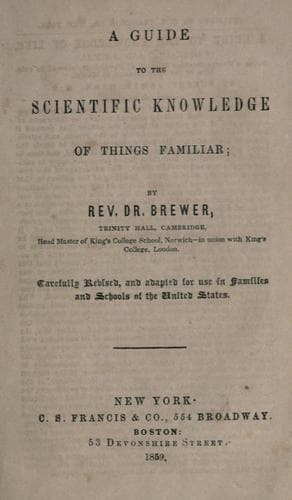
A Guide to the Scientific Knowledge of Things FamiliarBrewer, Ebenezer Cobham
Science
A Guide to the Scientific Knowledge of Things Familiar
Brewer, Ebenezer Cobham
Science -- Juvenile literature
Q. _Why are there WAVES in the sea?_
A. The wind (acting on the surface of the sea) _piles up ridges of
water_, which leave behind an _indentation_: as the water on all sides
rushes to _fill up this indentation_, the disturbance spreads on all
sides, and billow rolls after billow.
Q. _Why does WIND in England generally feel COLD?_
A. Because a _constantly changing surface_ comes in contact with our
body, to draw off its heat.
Q. _Why is a ROOM (even without a fire) generally WARMER than the OPEN
AIR?_
A. As the air in a room is _not subject to much change_, it soon becomes
of the same temperature as our skin, and no longer feels cold.
Q. _Why do we generally feel COLDER out-of-doors?_
A. Because the air (which surrounds us) _is always changing_; and as
fast as _one_ portion of air has become warmer by contact with our body,
_another colder portion_ surrounds us to absorb more heat.
Q. _Why are HOT FOODS made COOL by BLOWING them?_
A. Blowing causes the air (which covers the hot food) _to change more
rapidly_; in consequence of which, the hot air is _quickly blown away_,
and gives place to fresh _cold air_.
Q. _Why do ladies FAN THEMSELVES in hot weather?_
A. By the action of the fan, _fresh particles of air_ are perpetually
brought in contact with the face, and every fresh particle of air
_absorbs some heat_ from the skin.
Q. _Does the fan COOL the AIR?_
A. No; it makes the _air hotter_, by imparting to it the heat _out of
our face_: but it cools the _face_ blown upon, by transferring its heat
to the _air_.
Q. _Is the AIR in SUMMER time ever so hot as our bodies?_
A. No, not in England. In the hottest day in summer, the air of England
is 15 or 20 degrees cooler than the human body.
Q. _How fast does wind travel?_
A. A gentle breeze goes at about the rate of 5 miles an hour. A high
wind from 20 to 60. A hurricane from 80 to 100 miles an hour.
Q. _How is the VELOCITY of WINDS ascertained?_
A. By observing the velocity of the clouds, and by an instrument for the
purpose.
This instrument is called an ANEMOMETER.
Q. _How is the VELOCITY of the CLOUDS ascertained?_
A. By observing the speed of their shadow along the ground; which is
found in a high wind to vary from 20 to 60 miles an hour.
Q. _Why is there always a strong DRAUGHT through the KEYHOLE of a door?_
A. As the air of the room we occupy is _warmer than the air in the
hall_, therefore the cold hall air _rushes through the keyhole_ into the
room, and causes a draught.
Q. _Why is there always a strong DRAUGHT UNDER the DOOR, and through the
crevice on each side?_
A. The cold air _rushes from the hall_ under the door, &c. into the
room, to supply the _void_ caused in the room (by the escape of warm
air up the chimney, &c.)
Q. _Why is there always a DRAUGHT through the WINDOW crevices?_
Public-domain text, read in full here on John Shaqi.
Reviews
Reviews
No reviews yet
Be the first to share your thoughts on this work.
Elsewhere in the archive
Join the Discussion
Join the discussion
Sign in to leave a comment or review.
Sign InorCreate an account