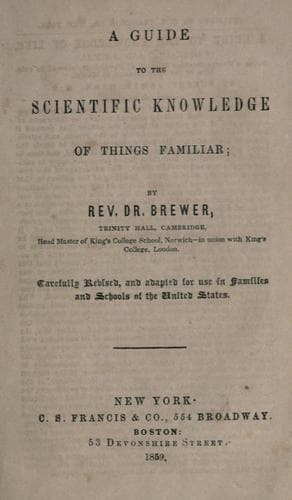
A Guide to the Scientific Knowledge of Things FamiliarBrewer, Ebenezer Cobham
Science
A Guide to the Scientific Knowledge of Things Familiar
Brewer, Ebenezer Cobham
Science -- Juvenile literature
A. The external air (being colder than the air of the room we occupy)
rushes through the window crevices _to supply the deficiency_, caused by
the escape of air up the chimney, &c.
Q. _Why is there more DRAUGHT if you open the LOWER SASH of a window,
than if you open the UPPER sash?_
A. If the _lower_ sash be open, the _cold external air_ will rush more
freely _into the room_; but if the _upper_ sash be open the _heated air
of the room_ will _rush out_; and (of course) there will be less
draught.
Q. _By which means is the ROOM better VENTILATED, by opening the lower
or the upper sash?_
A. A room is better _ventilated_ by opening the _upper sash_; because
the hot vitiated air (which always ascends towards the ceiling) _can
better escape_.
Q. _By which means is a HOT ROOM more quickly COOLED--By opening the
upper or the lower sash?_
A. A hot room is _cooled more quickly_ by opening the _lower sash_;
because the cold air can enter more freely by an _under_ current, than
by one _higher up_.
Q. _Why does WIND DRY damp LINEN?_
A. Because dry wind (like a dry sponge) imbibes the particles of vapour
from the surface of the linen, as fast as they are formed.
Q. _Which is the HOTTEST PLACE in a church, chapel, or theatre?_
A. The gallery.
Q. _Why is the GALLERY of all public places HOTTER than the lower parts
of the building?_
A. Because the heated air of the room _ascends_, and all the _cold air_
(which can enter through the doors and windows) _keeps to the floor_,
till it has become heated.
Q. _Why do PLANTS often grow out of WALLS and TOWERS?_
A. Because sometimes the _wind_ blows the seed there with the dust; and
sometimes _birds_ (flying over) drop the seed which they had formerly
eaten.
CHAPTER XXIII.
BAROMETER.
Q. _What is a BAROMETER?_
A. A weather-glass, or instrument to show the changes of the weather, by
marking the _variations in the weight of air_.
Q. _What is a THERMOMETER?_
A. An instrument to show how _hot or cold_ anything is.
Q. _What is the DIFFERENCE between a THERMOMETER and a BAROMETER?_
A. In a THERMOMETER the mercury is _sealed up from the air_:
In a BAROMETER the mercury is left _exposed_ (or open) to the air.
Q. _If the mercury of the thermometer be SEALED UP from the air, how can
the air AFFECT it?_
A. The heat of the air passing _through the glass tube_ into the
mercury, causes it to _expand more or less_, and rise in the tube
accordingly.
Q. _Why is the TUBE of a BAROMETER left OPEN?_
A. That the air may _press upon it_ freely; and as this pressure is
_more_ or _less_, the mercury _rises or falls_ in the tube.
Q. _How can weather be affected by the WEIGHT of the air?_
A. When air is warm or moist, it is _lighter_ than usual:
When it is cold or dry, it is _heavier_: and as a barometer marks
whether the air be _light_ or _heavy_, it indicates these _changes_.
Q. _How can you tell (by looking at a BAROMETER) what KIND of WEATHER it
will be?_
Public-domain text, read in full here on John Shaqi.
Reviews
Reviews
No reviews yet
Be the first to share your thoughts on this work.
Elsewhere in the archive
Join the Discussion
Join the discussion
Sign in to leave a comment or review.
Sign InorCreate an account