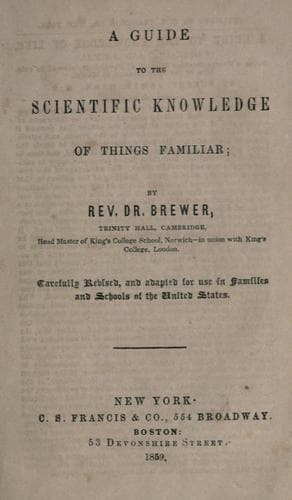
A Guide to the Scientific Knowledge of Things FamiliarBrewer, Ebenezer Cobham
Science
A Guide to the Scientific Knowledge of Things Familiar
Brewer, Ebenezer Cobham
Science -- Juvenile literature
A. Because it supplies it with _moisture_ for a considerable time; which
penetrates slowly into the soil, and insinuates itself through every
clod, ridge, and furrow.
Q. _Why is there NO SNOW in SUMMER time?_
A. No snow reaches the general surface of the earth in summer time,
because the _heat of the earth_ melts it in its descent.
Q. _Why are some MOUNTAINS ALWAYS COVERED with SNOW?_
A. 1st--Because the _air is more rarefied_; and rarefied air _abstracts
heat_ which it holds in a _latent state_:
2ndly--As the mountain top is _not surrounded by earth_ to radiate heat
into the air; therefore, the snow is _not melted_ in its descent, but
falls on the mountain, and lies there.
Q. _Why is SNOW WHITE?_
A. Snow is formed of an infinite number of very minute crystals and
prisms, which reflect all the colours of the rays of light; and these
colours _uniting_ before they meet the eye, cause snow to appear white.
Q. _What is HAIL?_
A. Rain, which has passed in its descent _through some cold bed of air_,
and has been frozen into drops of ice.
Q. _Why is ONE bed of air COLDER than another?_
A. This is frequently caused by _electricity_ in the air, _unequally
distributed_.
Q. _Why is HAIL frequently accompanied with THUNDER and LIGHTNING?_
A. 1st--Because the _congelation of water into hail_ disturbs the
electricity of the air: and
2ndly--The _friction_ (produced by the fall of hail) excites it still
more.
Q. _Why does HAIL fall generally in SUMMER and AUTUMN?_
A. 1st--Because the _air is more highly electrified_ in summer and
autumn: and
2ndly--The vapours (being rarefied) ascend to the more elevated regions,
where the _cold is greater_ than it is nearer the earth.
Q. _What TWO things are essential to cause HAIL?_
A. Two _strata of clouds_ having _opposite electricities_, and _two
currents of wind_. The _lower cloud_ (being negative) is the one
_precipitated_.
Q. _What is RAIN?_
A. The vapour of the clouds or air _condensed_, and precipitated to the
earth.
Q. _Why is the vapour of the air or clouds PRECIPITATED?_
A. When the air is _saturated with vapour_, if a cold current
_condenses_ it, it is no longer _able to hold all its vapour_ in
solution, and some of it is squeezed out, and falls as rain.
Q. _Why does RAIN fall in DROPS?_
A. The vapoury particles in their descent _attract each other_; and
those which are sufficiently near, _unite_ and form into a drop.
Q. _Why does not the COLD of NIGHT ALWAYS cause rain?_
A. When the air is not _near saturation_ (although condensed by the
chill of evening), it will still be able to hold its vapour in solution.
Q. _Why does a PASSING CLOUD often drop RAIN?_
A. Because the cloud (travelling about on the wind) comes into contact
with _something that chills it_; and its vapour being squeezed out,
_falls to the earth as rain_.
Q. _Why are RAIN-DROPS sometimes much LARGER than at OTHER times?_
Public-domain text, read in full here on John Shaqi.
Reviews
Reviews
No reviews yet
Be the first to share your thoughts on this work.
Elsewhere in the archive
Join the Discussion
Join the discussion
Sign in to leave a comment or review.
Sign InorCreate an account