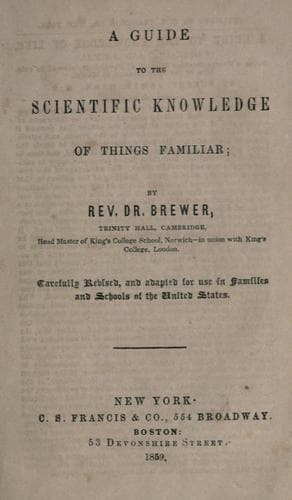
A Guide to the Scientific Knowledge of Things FamiliarBrewer, Ebenezer Cobham
Science
A Guide to the Scientific Knowledge of Things Familiar
Brewer, Ebenezer Cobham
Science -- Juvenile literature
If _fair_ weather happens _soon_ after the rise of the barometer, expect
but _little_ of it.
In _wet_ weather, if the mercury rises high and _remains_ so, expect
continued _fine_ weather in a day or two.
In wet weather, if the mercury rises suddenly very high, fine weather
will not last long.
N. B. The barometer rises highest of all for north and east winds; for
all _other_ winds it sinks.
* * * * *
If the barometer be UNSETTLED.
If the motion of the mercury be _unsettled_, expect unsettled weather.
If it stand at "MUCH RAIN" and rise to "CHANGEABLE," expects _fair
weather of short continuance_.
If it stand at "FAIR" and fall to "CHANGEABLE," expect _foul_ weather.
N. B. Its motion _upwards_ indicates the approach of fine weather: its
motion _downwards_ indicates the approach of foul weather.
CHAPTER XXIV.
SNOW. HAIL. RAIN.
Q. _What is SNOW?_
A. The condensed vapour of the air _frozen_, and precipitated to the
earth.
Q. _What is the CAUSE of SNOW?_
A. When the air is nearly saturated with vapour, and condensed by a
current of air _below freezing point_, some of the vapour is squeezed
out, and frozen into snow.
A few years ago, some fishermen (who wintered at Nova-Zembla), after
they had been shut up in a hut for several days, _opened the window_,
and the cold external air rushing in, instantly condensed the air of the
hut, and the vapour (which was squeezed out) fell on the floor _in a
shower of snow_.
Q. _Why does SNOW fall in WINTER time?_
A. Because the sun's rays are too _oblique_ to heat the surface of the
earth; and (as the _earth has no heat_ to radiate into the air) the air
is very cold.
Q. _What is SLEET?_
A. When flakes of snow (in their descent) pass through a bed of air
_above freezing point_, they melt; and fall to the earth as half-melted
snow or sleet.
Q. _What is the USE of SNOW?_
A. To keep the _earth warm_, and to _nourish_ it.
Q. _How can snow keep the EARTH WARM?_
A. Because it is a very _bad conductor_; in consequence of which, the
earth which is covered with snow, very rarely descends _below freezing
point_, even when the air is 15 or 20 degrees colder.
Q. _Why is SNOW a BAD CONDUCTOR of heat and cold?_
A. Because _air_ is confined and entangled between the crystals, and
_air_ is a very _bad conductor_; when, therefore, the earth is covered
with snow, it cannot throw off its heat by radiation.
Q. _Tell me the words of the PSALMIST_ (cxlvii. 16.) _respecting snow,
and explain what he means._
A. The Psalmist says--"The Lord giveth snow like wool:" and he means not
only that snow is as _white as wool_, but that it is also as _warm as
wool_.
Q. _Why is WOOL WARM?_
A. Because _air_ is entangled between the fibres of the wool, and air is
a _bad conductor_.
Q. _Why is SNOW WARM?_
A. Because _air_ is entangled between the crystals of the snow, and air
is a _bad conductor_.
Q. _Why does SNOW NOURISH the earth?_
Public-domain text, read in full here on John Shaqi.
Reviews
Reviews
No reviews yet
Be the first to share your thoughts on this work.
Elsewhere in the archive
Join the Discussion
Join the discussion
Sign in to leave a comment or review.
Sign InorCreate an account