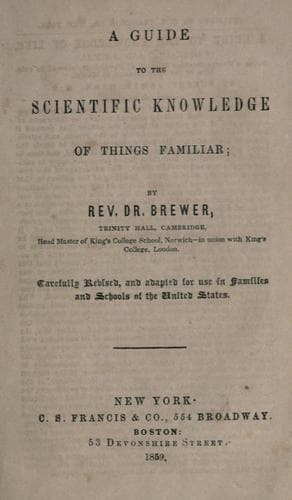
A Guide to the Scientific Knowledge of Things FamiliarBrewer, Ebenezer Cobham
Science
A Guide to the Scientific Knowledge of Things Familiar
Brewer, Ebenezer Cobham
Science -- Juvenile literature
Q. _Why is it difficult to wash in SALT WATER?_
A. Because salt water contains _muriatic acid_; and the _soda of soap_
combines with the _muriatic acid of the salt water_, and produces a
cloudiness.
Q. _Why does a BLACK HAT turn RED at the SEA SIDE?_
A. The _muriatic acid of the sea-water_ disturbs the _gallic acid of the
black dye_, and turns it _red_.
Q. _Of what is SOAP made?_
A. Of kelp (or the ashes of sea-weed dried and burnt in a pit) mixed
with oil or fat.
YELLOW SOAP is made of whale-oil, soda, and resin. SOFT SOAP is made of
oil and potash. HARD SOAP of oil and soda.
Q. _Why does WATER CLEAN dirty LINEN?_
A. Because the _oxygen_ of the water attaches itself to the _stains of
the linen_, and _dissolves_ them; as oxalic acid dissolves ink spots.
Q. _Why does SOAP greatly INCREASE the cleansing power of water?_
A. 1st--Because soap _increases the oxygen_ of the water: and
2ndly--It _neutralizes the grease_ of the things washed.
Q. _Why is RAIN WATER SOFT?_
A. Because it has _not come in contact with earths and minerals_.
Q. _Why is it MORE EASY to WASH with SOFT water than with HARD?_
A. Because it unites freely with the soap, _dissolving_ it instead of
_decomposing it_, as hard water does.
Q. _Why do WOOD ASHES make HARD water SOFT?_
A. 1st--Because the _carbonic acid of the wood ashes_ combines with the
_sulphate of lime in the hard water_, and converts it into _chalk_: and
2ndly--The _sulphuric acid of the water_ combines with the _potash of
the wood ashes_, and prevents it from neutralizing the oily matter of
the soap.
Q. _Why has RAIN water such an UNPLEASANT SMELL, when it is collected in
a rain water tub or tank?_
A. Because it is impregnated with _decomposed organic matter_, washed
from roofs, trees, or the casks in which it is collected.
Q. _Why does WATER MELT SUGAR?_
A. Because very minute particles of water _insinuate themselves into
the pores_ of the sugar, and force the crystals _apart from each other_.
Q. _Why does WATER MELT SALT?_
A. Because very minute particles of water insinuate themselves into the
_pores of the salt_, and force the crystals _apart from each other_.
Q. _Why does melted SUGAR or SALT give a FLAVOUR to the WATER?_
A. Because the sugar or salt (being disunited into very minute pieces)
_floats about the water_, and mixes with _every part_.
Q. _Why does HOT water melt sugar and salt QUICKER than COLD water?_
A. 1st--Because the _heat_ of the water entering the pores of the sugar
or salt, _opens a passage for the water_: and
2ndly--The _particles of hot water_ being _smaller_ than those of cold,
can _more readily penetrate_ the pores of salt or sugar.
Q. _Why is SEA-water SALT?_
A. 1st--Because it contains _mines of salt_ at the bottom of its bed:
2ndly--It is impregnated with _bituminous matter_, which is brackish:
and
3rdly--It contains many _putrid substances_, which increase its
brackishness.
Public-domain text, read in full here on John Shaqi.
Reviews
Reviews
No reviews yet
Be the first to share your thoughts on this work.
Elsewhere in the archive
Join the Discussion
Join the discussion
Sign in to leave a comment or review.
Sign InorCreate an account