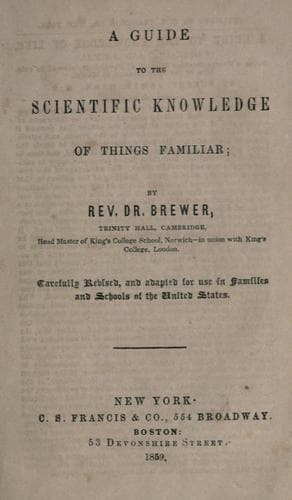
A Guide to the Scientific Knowledge of Things FamiliarBrewer, Ebenezer Cobham
Science
A Guide to the Scientific Knowledge of Things Familiar
Brewer, Ebenezer Cobham
Science -- Juvenile literature
Q. _Why is NOT RAIN-water SALT, although most of it is evaporated from
the SEA?_
A. Because _salt will not evaporate_; and, therefore, when sea-water is
turned to vapour, its _salt is left behind_.
Q. _Why does STAGNANT water PUTREFY?_
A. Because leaves, plants, insects, &c. are decomposed in it.
Q. _Why is STAGNANT water full of WORMS, EELS, &c.?_
A. Because numberless insects _lay their eggs_ in the leaves and plants
which float on the surface; these eggs are soon hatched, and produce
swarms of worms, eels, and insects.
Q. _Why are FLOWING waters FREE from these IMPURITIES?_
A. 1st--Because the motion of running water _prevents its fermentation:_
2ndly--It _dissolves the putrid substances_ which happen to fall into
it: and
3rdly--It casts _on the bank_ (by its current) such substances as it
cannot _dissolve_.
Q. _Why does RUNNING water OSCILLATE and WHIRL in its current?_
A. 1st--Because it _impinges against its banks_, and is perpetually
diverted from its forward motion: and
2ndly--Because the _centre_ of a river _flows faster_ than its _sides_.
Q. _Why do the SIDES of a river flow more TARDILY than its CENTRE?_
A. Because they _rub against the banks_, and are delayed in their
current thereby.
Q. _Why does SOAPY water BUBBLE?_
A. Because the soap _makes the water tenacious_, and prevents the
bubbles from _bursting_ as soon as they are formed.
Q. _Why will not water bubble WITHOUT SOAP?_
A. Because it is not tenacious enough _to hold together the bubbles_
that are formed.
Q. _When SOAP BUBBLES are blown from a pipe, why do they ASCEND?_
A. Because they are _filled with warm breath_, which is lighter than
air.
CHAPTER XXVI.
ICE.
Q. _What is ICE?_
A. FROZEN WATER. When the air is reduced to 32 degrees of heat, water
will no longer remain in a _fluid state_.
Q. _Why is SOLID ICE LIGHTER than WATER?_
A. Because water _expands by freezing_; and as the _bulk is increased_,
the _gravity_ must be _less_.
Nine cubic inches of water become ten when frozen.
Q. _Why do EWERS BREAK in a FROSTY NIGHT?_
A. Because the water in them _freezes_; and as the _water is expanded by
frost_, it bursts the ewers to make room for its increased volume.
Q. _Why does it not expand UPWARDS (like boiling water), and RUN OVER?_
A. Because the _surface_ is first frozen, and the frozen surface acts as
a _plug_, which is more difficult to burst than the earthen ewer
itself.
Q. _Why do TILES, STONES, and ROCKS often SPLIT in winter?_
A. Because the moisture (which they imbibed) _freezes_, and by its
expansion _splits the solid mass_.
Q. _In winter time, FOOT-MARKS and WHEEL-RUTS are often covered with an
icy NET-WORK, through the interstices of which the soil is clearly
seen,--WHY does the water freeze in NET-WORK?_
Public-domain text, read in full here on John Shaqi.
Reviews
Reviews
No reviews yet
Be the first to share your thoughts on this work.
Elsewhere in the archive
Join the Discussion
Join the discussion
Sign in to leave a comment or review.
Sign InorCreate an account