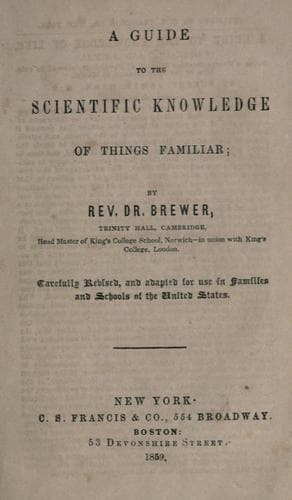
A Guide to the Scientific Knowledge of Things FamiliarBrewer, Ebenezer Cobham
Science
A Guide to the Scientific Knowledge of Things Familiar
Brewer, Ebenezer Cobham
Science -- Juvenile literature
A. Because the pupil _dilates_ again, and is able to gather together
more rays; in consequence of which, we see more distinctly.
Q. _If we look at the SUN for a few moments, why do all OTHER things
appear DARK?_
A. Because the pupil of the eye (which was _very much contracted_ by
looking at the sun) is _too small_ to collect sufficient rays from
_other objects_, to enable us to distinguish their colours. (_See_
"accidental colours.")
Q. _If we watch a bright FIRE for a few moments, why does the ROOM seem
DARK?_
A. Because the pupil of the eye (which was very much _contracted_ by
looking at the fire) is _too small_ to collect sufficient rays from the
objects around, to enable us to distinguish their colours.
Q. _Why can we see the PROPER COLOUR of every object again, after a few
minutes?_
A. Because the pupil _dilates_ again, and accommodates itself to the
light around.
Q. _Why can TIGERS, CATS, and OWLS see in the DARK?_
A. Because they have the power of _enlarging the pupil of their eyes_,
so as to collect several scattered rays of light; in consequence of
which, they can _see distinctly_ when it is not light enough for us to
see _any thing at all_.
Q. _Why do CATS and OWLS SLEEP almost all DAY?_
A. As the pupil of their eyes is _very broad_, daylight _fatigues_ them;
so they close their eyes for relief.
Q. _Why do CATS keep WINKING, when they sit before a FIRE?_
A. As the pupil of their eyes is _very broad_, the light of the fire
_pains_ them; and they keep shutting their eyes to relieve the sensation
of too much light.
Q. _Why do TIGERS, CATS, OWLS, &c. PROWL by NIGHT for prey?_
A. As these animals cannot see distinctly in _strong daylight_, they
_sleep_ during the _day_: and as they can see clearly in the _dark_,
they prowl then for prey.
Q. _Why do GLOW-WORMS glisten by NIGHT only?_
A. Because the light of day is _so much stronger_, that it _eclipses_
the feeble light of a glow-worm; in consequence of which, glow-worms are
_invisible by day_.
Q. _Why can we not see the STARS in the DAY-TIME?_
A. Because the light of day is so powerful, that it _eclipses the feeble
light of the stars_: in consequence of which, they are invisible by day.
Q. _Why can we see the STARS even at MID-DAY, from the bottom of a deep
WELL?_
A. As the rays of the sun never come _directly over a well_, but the
rays of the _stars_ do; therefore the light from those stars (in such a
situation) is more clear than the light of the _sun_.
Q. _What is the USE of TWO EYES, since they present only one image of
any object?_
A. The use of two eyes is to _increase the light_, or take in _more rays
of light_ from the object looked at, in order that it may appear _more
distinct_.
Q. _Why do we NOT see things DOUBLE, with TWO EYES?_
A. 1st--Because the _axis of both eyes is turned to one object_; and,
therefore, the _same impression_ is made on the ret´ina of _each eye_.
Public-domain text, read in full here on John Shaqi.
Reviews
Reviews
No reviews yet
Be the first to share your thoughts on this work.
Elsewhere in the archive
Join the Discussion
Join the discussion
Sign in to leave a comment or review.
Sign InorCreate an account