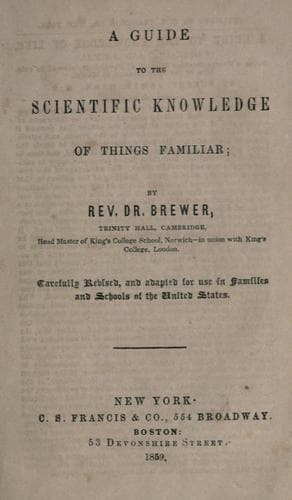
A Guide to the Scientific Knowledge of Things FamiliarBrewer, Ebenezer Cobham
Science
A Guide to the Scientific Knowledge of Things Familiar
Brewer, Ebenezer Cobham
Science -- Juvenile literature
Q. _How are FISHES able to ASCEND to the SURFACE of water?_
A. Fishes have an _air-bladder_ near their abdomen: when this bladder is
_filled with air_, the fish increases in size; and (being lighter)
ascends through the water to its surface.
Q. _How are fishes able to DIVE in a minute to the BOTTOM of a stream?_
A. They _expel the air_ from their air-bladder; in consequence of which,
their _size is diminished_, and they sink instantly.
CHAPTER XXVII.
LIGHT.
Q. _What is LIGHT?_
A. Rapid undulations of a fluid called ether, striking on the optic
nerve of the eye. (_See p. 46._)
The _heat_ of fire or of the sun sets the atoms of _matter_ in motion;
and these atoms, striking against the fluid _ether_, cause it to
undulate.
Q. _How FAST does LIGHT TRAVEL?_
A. Light travels so fast, that it would go eight times round the earth,
while a person counts "ONE."
Q. _Does ALL light travel equally fast?_
A. Yes; the light of the sun, or the light of a candle, or the light
from houses, trees, and fields.
Q. _Where does the LIGHT of HOUSES, TREES, and FIELDS come from?_
A. The light of the _sun_ (or of some lamp or candle) is _reflected from
their surfaces_.
Q. _Why are SOME surfaces BRILLIANT like glass and steel, and OTHERS
DULL like lead?_
A. Those surfaces which _reflect the most light_, are the most
_brilliant_; and those which _absorb_ light are _dull_.
Q. _What is meant by REFLECTING LIGHT?_
A. Throwing the rays of light _back again_, from the surface on which
they light.
Q. _What is meant by ABSORBING LIGHT?_
A. Letting the rays of light _sink below the surface_ which they touch,
so as not to be seen.
Q. _Why can a THOUSAND persons SEE the SAME OBJECT at the same time?_
A. Because it throws off from its surface _an infinite number of rays in
all directions_; and one person sees _one_ portion of these rays, and
another person _another_.
Q. _Why is the EYE PAINED by a SUDDEN light?_
A. Because the pupil of the eye is _burdened with rays_, before it has
had time to contract.
Q. _Why does it give us PAIN, if a CANDLE be brought suddenly towards
our BED at night time?_
A. In the dark _the pupils of the eyes dilate_ very much, in order to
_admit more rays_. When a candle is brought before them, the enlarged
pupil is _overladen with rays_, and feels pained.
Q. _Why CAN we BEAR the candle-light after a few moments?_
A, Because the pupil _contracts again_ almost instantly, and adjusts
itself to the quantity of light which falls upon it.
Q. _Why can we SEE NOTHING, when we leave a WELL-LIGHTED room, and go
into the DARK ROAD or street?_
A. Because the pupil (which _contracted_ in the bright room) does not
_dilate instantaneously_; and the contracted pupil is not able to
_collect rays enough_ (from the dark road or street) to enable us to see
before us.
Q. _Why do we SEE BETTER, when we get USED to the dark?_
Public-domain text, read in full here on John Shaqi.
Reviews
Reviews
No reviews yet
Be the first to share your thoughts on this work.
Elsewhere in the archive
Join the Discussion
Join the discussion
Sign in to leave a comment or review.
Sign InorCreate an account