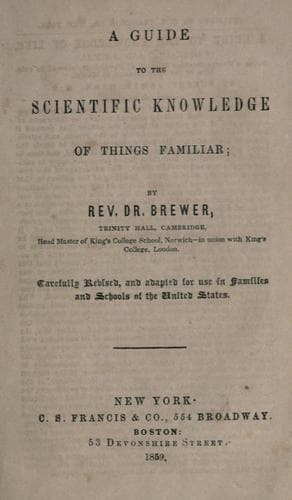
A Guide to the Scientific Knowledge of Things FamiliarBrewer, Ebenezer Cobham
Science
A Guide to the Scientific Knowledge of Things Familiar
Brewer, Ebenezer Cobham
Science -- Juvenile literature
A. Because bluish green is the "ACCIDENTAL COLOUR" of red: and if we fix
our eye upon _any colour whatsoever_, when we turn aside, we see every
object tinged with _its accidental colour_.
Q. _If we wear BLUE GLASSES, (when we take them off,) every thing
appears tinged with ORANGE,--WHY is this?_
A. Because _orange_ is the "_accidental colour_" of blue: and if we look
through _blue glasses_, we shall see its "_accidental colour_," when we
lay our glasses aside.
Q. _If we look at the SUN for a few moments, every thing seems tinged
with a VIOLET colour,--WHY is this?_
A. Because _violet_ is the "accidental colour" of _yellow_ light; and as
the sun is _yellow_, we shall see its "accidental colour" _blue_, when
we turn from gazing at it.
Q. _Does not the DARK SHADOW (which seems to hang over every thing after
we turn from looking at the sun) arise from our eyes being DAZZLED?_
A. Partly so: the pupil of the eye is _very much contracted_ by the
brilliant light of the sun, and does not adjust itself immediately to
the feebler light of terrestrial objects; but, independent of this, the
"ACCIDENTAL COLOUR" of the sun being _dark violet_, would tend to throw
a shadow upon all things. (_See p. 366._)
Q. _Why is BLACK glass for spectacles the BEST for wear?_
A. Because _white_ is the accidental colour of _black_; and if we wear
_black glasses_, every thing will appear _in white light_, when we take
them off.
Q. _Why does every thing seem shadowed with a BLACK MIST, when we take
off our common SPECTACLES?_
A. Because the glasses are _white_, and black being its "accidental
colour," every thing appears in a _black shade_, when we lay our glasses
down.
The accidental colour of red is bluish green.
" " " of orange " blue.
" " " of violet " yellow.
" " " of black " white.
And the converse of this is true:--
The accidental colour of bluish green is red.
" " " of blue " orange.
" " " of yellow " violet.
" " " of white " black.
(The law of an accidental colour is this--The accidental colour is
always half the spectrum. Thus, if we take half the length of the
spectrum by a pair of compasses, and fix one leg in any colour, the
other leg will hit upon its accidental colour.)
N. B. The spectrum means the seven colours--Red, orange, yellow, green,
blue, indigo, and violet, divided into seven equal bands, and placed
side by side in the order just mentioned.
CHAPTER XXVIII.
SOUND.
Q. _What is SOUND?_
A. The vibration of some sonorous substance produces motion in the air
called SOUND WAVES, which strike upon the _drum of the ear_, and give
the sensation of sound.
Q. _What are MUSICAL SOUNDS?_
A. Regular and uniform successions of vibrations, which are always
pleasing to the ear.
Q. _How FAST does SOUND TRAVEL?_
A. About 13 miles in a minute, or 1142 feet in a second of time.
Public-domain text, read in full here on John Shaqi.
Reviews
Reviews
No reviews yet
Be the first to share your thoughts on this work.
Elsewhere in the archive
Join the Discussion
Join the discussion
Sign in to leave a comment or review.
Sign InorCreate an account