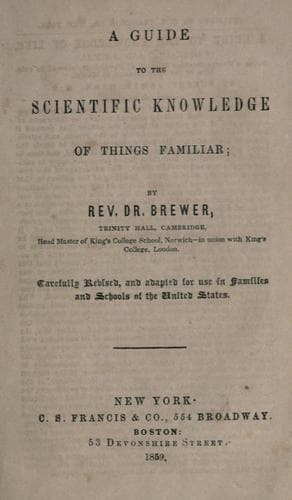
A Guide to the Scientific Knowledge of Things FamiliarBrewer, Ebenezer Cobham
Science
A Guide to the Scientific Knowledge of Things Familiar
Brewer, Ebenezer Cobham
Science -- Juvenile literature
Q. _How fast does LIGHT TRAVEL?_
A. Light would go 8 times round the whole earth, while sound is going
its 13 miles.
Q. _Why are SOME things SONOROUS, and others NOT?_
A. The sonorous quality of any substance depends upon its _hardness and
elasticity_.
Q. _Why are COPPER and IRON SONOROUS, and not LEAD?_
A. Copper and iron are _hard and elastic_; but as lead is neither hard
nor yet elastic, it is _not sonorous_.
Q. _Of what is BELL-METAL made?_
A. Of _copper and tin_ in the following proportions:--In every 5 pounds
of bell-metal, there should be 1 lb. of tin, and 4 lbs. of copper.
Q. _Why is this mixture of tin and copper used for BELL-METAL?_
A. Because it is much _harder_ and more _elastic_ than either of the
pure metals.
Q. _Why is the SOUND of a bell STOPPED by TOUCHING the bell with our
finger?_
A. The weight of the finger _stops the vibrations_ of the bell; and as
soon as the bell _ceases to vibrate_, it ceases to make sound-waves in
the air.
Q. _Why does a SPLIT BELL make a HOARSE disagreeable sound?_
A. The _split_ of the bell causes a _double vibration_; and as the
sound-waves _clash and jar_, they impede each other's motion, and
produce discordant sounds.
Q. _Why does a FIDDLE-STRING give a musical sound?_
A. The bow drawn across the string _causes it to vibrate_, and this
vibration of the string _sets in motion the sound-waves of the air_, and
produces musical notes.
Q. _Why does a DRUM sound?_
A. The parchment head of the drum _vibrates_ from the blow of the
drum-stick, and sets in motion the sound-waves of the air.
Q. _Why do MUSICAL GLASSES give sounds?_
A. Because the glasses _vibrate_ as soon as they are struck, and set in
motion the sound-waves of the air.
Q. _Why do FLUTES, &c. produce musical sounds?_
A. The breath of the performer causes the _air in the flute to vibrate_,
and sets in motion the sound-waves of the air.
Q. _Why do PIANO-FORTES produce musical sounds?_
A. The _keys of the piano_ (being struck with the finger) lift up a
little hammer which _knocks against a string_; and the vibration thus
produced, sets in motion the sound-waves of the air.
Q. _Why are SOME notes BASS and some TREBLE?_
A. _Slow_ vibrations produce _bass or deep sounds_; whereas, _quick_
vibrations produce _shrill or treble sounds_.
Q. _Why is an instrument FLAT when the STRINGS are UNSTRUNG?_
A. Because the vibrations are _too slow_; in consequence of which, the
sounds produced are not _shrill_ or _sharp_ enough.
Q. _Why can persons living a mile or two from_
_a town HEAR the BELLS of the town-church SOME TIMES, and not at
OTHERS?_
A. Fogs, rain, and snow, obstruct the passage of sound; but when the air
is _cold and clear_, sound is propagated more easily.
Q. _Why can we NOT hear sounds (as distant church bells) in RAINY
weather, so well as in FINE weather?_
A. Because the falling rain _interferes with the undulations of the
sound-waves_, and breaks them up.
Public-domain text, read in full here on John Shaqi.
Reviews
Reviews
No reviews yet
Be the first to share your thoughts on this work.
Elsewhere in the archive
Join the Discussion
Join the discussion
Sign in to leave a comment or review.
Sign InorCreate an account