A Guide to the Scientific Knowledge of Things Familiar — John Shaqi
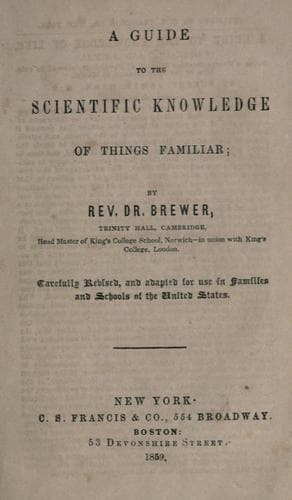
A Guide to the Scientific Knowledge of Things FamiliarBrewer, Ebenezer Cobham
Science
A Guide to the Scientific Knowledge of Things Familiar
Brewer, Ebenezer Cobham
Science -- Juvenile literature
A. When a cloud, _overcharged_ with electric fluid, approaches another
which is _under-charged_, the fluid rushes from the former into the
latter, till both have the same quantity.
Q. _Is there any OTHER cause of lightning, besides the one just
mentioned?_
A. Yes; sometimes mountains, trees, and steeples, will discharge a
lightning cloud floating near; and sometimes electric fluid rushes out
of the _earth_, into the clouds.
Q. _What produces ELECTRICITY in the CLOUDS?_
A. 1st--The evaporation from the earth's surface.
2ndly--The chemical changes perpetually going on: and
3rdly--Currents of air of unequal temperature, excite electricity by
_friction_, as they pass by each other.
Q. _How HIGH are the LIGHTNING-CLOUDS from the earth?_
A. Electrical clouds are the _lowest of all clouds_; they are rarely
more than 700 yards above the ground; and sometimes, they actually
_touch the earth_ with one of their edges.
Q. _How high are the clouds generally?_
A. In a _fine_ day, the clouds are often 4 or 5 miles above our head;
but the average height of the clouds is from 1-1/2 to 2 miles.
Q. _Why is lightning sometimes_ FORKED?
A. When the lightning-cloud is a long way off, the _resistance of the
air_ is so great, that the electrical current is diverted into a zig-zag
course.
Q. _Why does the resistance of the air make the lightning zig-zag?_
A. As the lightning _condenses_ the air, in the immediate advance of its
path; it keeps flying from side to side, in order to pass where there is
the _least resistance_.
Q. _How does lightning_ CONDENSE _the air in the immediate advance of
its path_?
A. The air is condensed by the _rapidity_ of the lightning-flash.
Q. _Why is_ FORKED LIGHTNING _more_ DANGEROUS _than a straight flash_?
A. Whatever _resists_ the flash, _diverts its course_; and when
_terrestrial_ objects offer resistance to the current, they are in great
danger of being destroyed.
Q. _Why are there sometimes_ TWO _flashes of forked lightning at the
same moment_?
A. Sometimes (in very severe storms) a flash of lightning will divide
_into two or more parts_; and then each branch assumes the zig-zag
form.
Q. _Why is the FLASH sometimes quite STRAIGHT?_
A. When the lightning-cloud hovers _near the earth_, as the flash meets
with very little resistance, it is _not diverted_; or (in other words)
the flash is straight.
Q. _What is the cause of_ SHEET LIGHTNING?
A. It is only the _reflection of distant flashes_, not distinctly
visible: and sometimes several flashes (from different clouds)
intermingle, and form one vast blaze or sheet of lightning.
Q. _Which_ FORM _of lightning is the most_ DANGEROUS?
A. The _ball_ of fire is by far the most dangerous; and the _zig-zag_
lightning is next in danger. _Sheet_ lightning is not often attended
with danger.
Q. _Why are_ BALLS OF FIRE _so very dangerous?_
Public-domain text, read in full here on John Shaqi.
Reviews
Reviews
No reviews yet
Be the first to share your thoughts on this work.
Join the Discussion
Join the discussion
Sign in to leave a comment or review.
Sign InorCreate an account